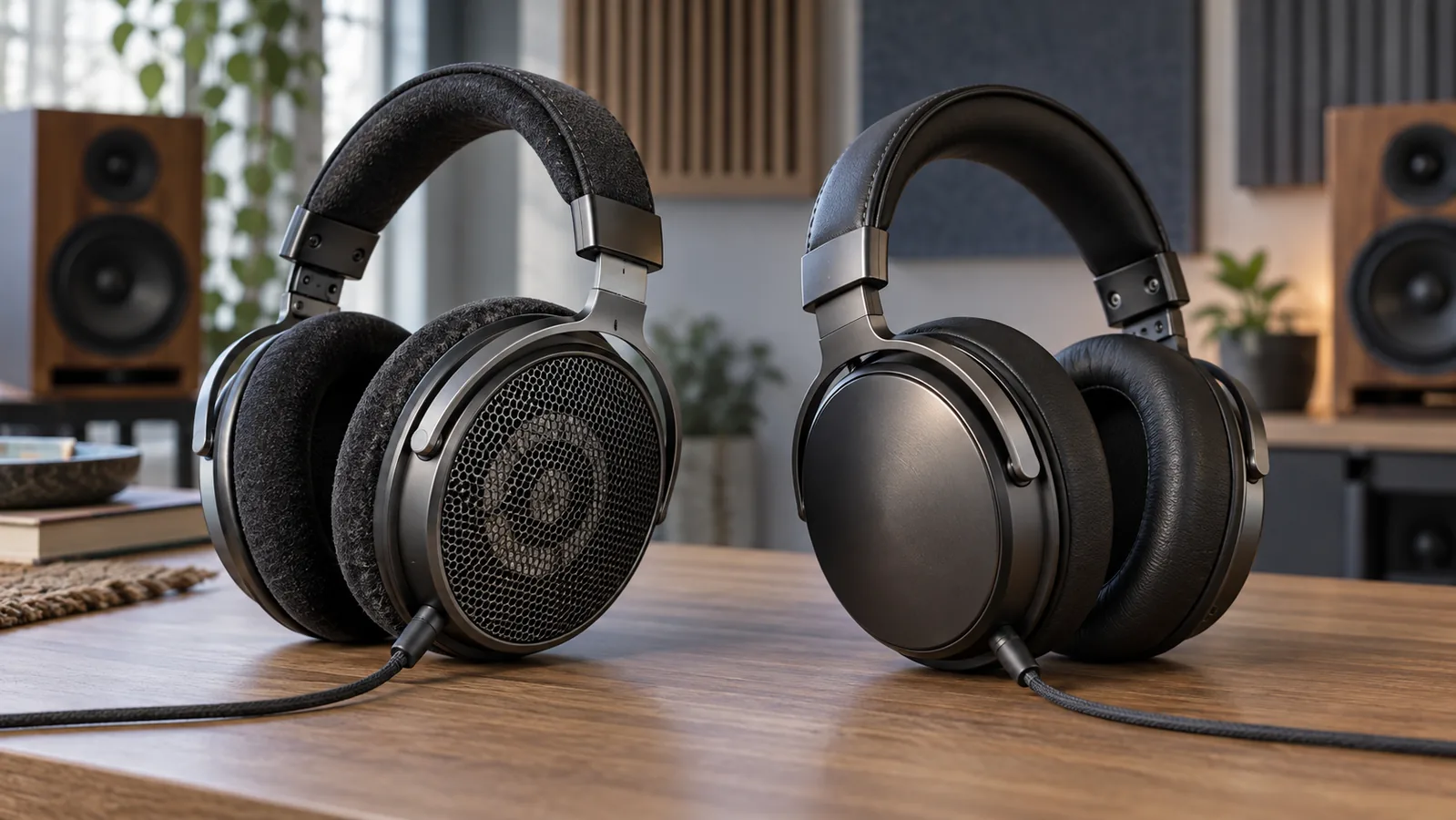
Closed vs open back headphones differ most clearly in what happens behind the driver. A closed-back cup contains the rear sound, while an open-back cup lets air and sound pass through vents or mesh. That choice changes isolation, leakage, and the designer’s acoustic constraints, but it does not create a guaranteed sound-quality ranking.
Quick answer: Choose closed-back headphones for privacy, passive isolation, portability, or low microphone bleed. Choose open-back headphones for focused listening in a quiet private room when spacious presentation and ventilation matter. Compare individual models for tuning, bass, comfort, and imaging; cup type alone cannot predict them.
Closed vs Open Back Headphones at a Glance
| Decision factor | Open-back | Closed-back | What it means in practice |
|---|---|---|---|
| Rear of ear cup | Vented or acoustically transparent | Solid or substantially sealed | Changes the acoustic load behind the driver |
| Outside-noise isolation | Usually low | Usually higher | Closed-back is normally easier to use on transport or in shared spaces |
| Sound leakage | Usually high | Usually lower | Open-back music may be audible to people nearby |
| Spatial presentation | Often perceived as wider or more external | Often more intimate | This is a tendency, not a rule for every model |
| Bass behaviour | Depends heavily on tuning and seal; some models have less sub-bass weight | Sealed designs can support strong low-frequency output | Do not infer bass quality from quantity |
| Long-session heat | Ventilation can reduce heat buildup | Pads and sealed cups may feel warmer | Pad material, clamp, weight, and anatomy still matter |
| Typical use | Quiet home listening, some mixing and mastering | Commuting, offices, recording, general-purpose use | Your environment is the first filter |
This is a screening tool. RTINGS stresses that these are trends: some closed-back models leak or isolate poorly, and a weak pad seal can change leakage and bass (RTINGS).
What the Back of the Ear Cup Actually Changes
A headphone driver moves forward and backward. The forward side produces sound toward the ear; the rear side also moves air. The housing determines how that rear energy is managed.
In an open-back design, perforations, grille, or acoustically transparent material connect the rear of the driver to the room. Ambient sound can enter, and headphone sound can leave. In a closed-back design, the rear cup forms an enclosed acoustic volume that must be controlled with its shape, internal damping, vents, pads, and driver tuning.
Beyerdynamic describes the same practical boundary in its support guidance: closed housings are designed to reduce incoming noise and spill, while open housings use acoustically transparent areas and allow the surroundings and the headphone signal to remain audible (beyerdynamic).
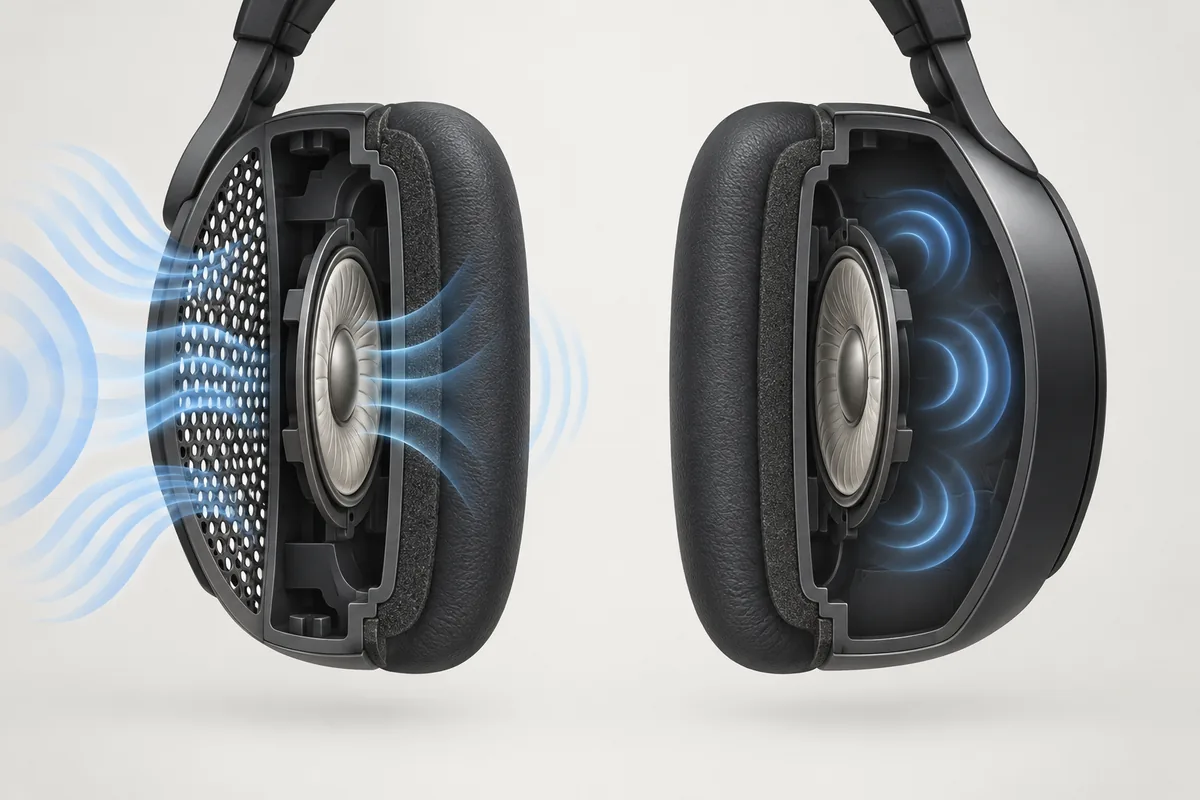
The enclosure is therefore part of the acoustic system, not a cosmetic lid. Closing an open design changes the driver load and introduces a cavity; removing a closed cup does not automatically create a well-tuned open headphone. Either modification requires measurement and retuning.
Isolation and Leakage Usually Decide First
Before comparing bass or soundstage, ask two questions: how much outside noise reaches you, and how much of your audio reaches other people?
Open-back headphones usually provide little passive isolation. In a quiet room, that may help you hear a doorbell or someone speaking. On transport or in a shared office, the same openness competes with music and removes privacy. Raising playback volume is a poor substitute for isolation.
Closed-back headphones create a physical barrier, although the result depends on the complete fit. Gaps around glasses, hair, jaw shape, or worn pads can weaken the seal. Active noise cancellation is a separate electronic system layered onto some mostly closed designs; it is not created by the solid cup itself. Our guide to how true wireless noise cancelling earbuds work explains the difference between passive isolation and active control.
Isolation also affects level choice. The World Health Organization notes that listening risk depends on level and duration and recommends well-fitted noise-cancelling headphones to reduce the need to turn music up in noisy places (WHO). A closed cup is not hearing protection by default, and quieter surroundings do not make unlimited playback volume safe.
Does Open-Back Mean Better Sound?
No. Open-back describes an enclosure approach, not a performance grade.
An open design gives the engineer different constraints. Without a sealed rear cavity, it can be easier to manage some reflections and pressure effects. Many listeners associate good open-back models with an airy presentation and less “inside the head” localisation. Beyerdynamic describes greater spaciousness as a tendency, not proof that every open model beats every closed one.
A closed-back headphone can control reflections with geometry, damping, vents, pads, and equalisation. It may have excellent imaging and neutral tuning, while an open model may be uneven or uncomfortable. Evaluate the actual model, not its price, driver type, or “audiophile” label.
Soundstage and imaging are not the same thing
Soundstage is the perceived size of the virtual space; imaging is how precisely sounds appear within it. A headphone can sound wide yet place objects vaguely, or compact yet locate cues precisely.
Open construction often supports a more external presentation, but driver angle, frequency response, channel matching, pads, and recording technique also matter. RTINGS notes that its pinna-related transfer-function measurement captures only part of subjective soundstage. A grille does not prove a “wide stage.”
Bass is a tuning and seal question
Closed-back headphones may deliver stronger bass because the rear volume and pad seal support low-frequency pressure. That does not make the bass deeper, tighter, or more accurate; resonance can sound boomy, while a pad leak can reduce low bass.
Some open models deliver less sub-bass impact, while others extend low and remain controlled. Compare measurements from the same test system, then listen for extension, balance, distortion, and consistency with glasses or head movement.
Use the Room-and-Microphone Test
The most useful choice tool is not a universal pros-and-cons list. It is a short constraint test based on where the headphones will operate.
| Question | If yes | Starting choice | Why |
|---|---|---|---|
| Will you listen around strangers, coworkers, or a sleeping partner? | Privacy matters | Closed-back | Lower leakage is usually more considerate and practical |
| Is the room noisy enough to mask quiet musical detail? | Isolation matters | Closed-back, possibly with ANC | Open cups admit the competing sound |
| Will a live microphone be close to the headphones? | Bleed matters | Closed-back | Less monitor signal reaches the microphone |
| Is the room quiet and private for the whole session? | Openness is usable | Open-back becomes a strong option | You can accept leakage and low isolation |
| Do you need to hear the room or another person naturally? | Awareness matters | Open-back may help | Ambient sound enters without microphone processing |
| Must one pair work at home, at work, and while travelling? | Versatility matters | Closed-back is the safer default | It remains usable in more environments |

This prevents a common mistake: choosing open-back for its reputation, then using it where noise erases detail. Solve privacy, noise, and microphone constraints first; then compare tuning, imaging, comfort, impedance, sensitivity, and price.
Which Design Fits Common Uses?
Quiet home listening
Open-back is a logical starting point in a quiet private room. Closed-back remains valid if you prefer its bass, need some household isolation, or simply like a particular model’s tuning.
Commuting, flights, and offices
Closed-back is usually practical because isolation and lower leakage matter more than spatial advantages masked by traffic or conversation. With wireless models, enclosure and transport are separate layers; our Bluetooth audio codecs guide explains why a codec badge cannot predict acoustic tuning.
Recording, mixing, and mastering
For tracking vocals or instruments, closed-back headphones reduce the chance that the monitor or click track will spill into a live microphone. Shure’s studio guidance recommends closed-back for tracking for this reason and describes open-back as an option for a more open presentation during mixing (Shure).
For mixing, neither type guarantees neutrality. Open-back can be comfortable and spacious, but translation still requires familiarisation, level matching, and checks on other playback systems. A familiar closed-back response can be more useful than an unfamiliar open model.
Gaming and calls
Open-back can feel less enclosed and lets you hear the room, but may leak into a sensitive microphone. Closed-back helps when fans or conversation interfere. For positional games, prioritise model-specific imaging and channel balance over the enclosure label.
How to Compare Two Headphones Fairly
- Match the listening environment. Test in the room where you will actually use them, then repeat in a quiet room so outside noise is not mistaken for a tonal difference.
- Match playback level. A slightly louder headphone often sounds clearer or more exciting. Use the same passage and adjust levels as closely as practical.
- Disable unrelated processing. Turn off EQ, spatial audio, loudness normalisation, and ANC unless the feature itself is under test.
- Check the seal. Wear glasses if you normally do, move your jaw, and note whether bass changes when you press the cups gently.
- Separate attributes. Record isolation, leakage, tonal balance, bass extension, imaging, comfort, and heat as different observations instead of one “quality” score.
- Repeat after ten minutes. Clamp pressure, pad temperature, and treble fatigue may matter more over a real session than during a showroom impression.
This controlled comparison reveals personal trade-offs; it cannot establish universal performance or replace comparable third-party measurements.
Semi-Open, Open-Ear, and Transparency Modes Are Different
“Semi-open” has no single universal amount of openness. It usually describes a partly vented cup, but its leakage and isolation can resemble an open design. Check measurements for the exact model rather than assuming it sits halfway between two categories.
Open-ear earbuds and bone-conduction products leave the ear canal open, which is a different physical arrangement from an over-ear open-back headphone. Transparency or hear-through mode is different again: microphones and speakers electronically reproduce outside sound. These products may share an awareness goal, but they do not share the same acoustic path.
FAQ
Are open-back headphones always wired?
No, but most are. Open-back models are commonly designed for stationary listening, while wireless electronics, batteries, microphones, and ANC are usually packaged in closed cups for portable use. A wireless open-back model is possible; verify its leakage, battery system, codec support, and intended environment separately.
Can people hear open-back headphones across a room?
It depends on playback level, music, distance, and the model. Someone beside you in a quiet room may hear the treble and midrange clearly. Leakage usually sounds thinner than it does to the wearer, but it can still disturb a colleague, housemate, or microphone.
Do closed-back headphones block all outside noise?
No. They normally reduce more ambient sound than open-back headphones, but pad seal, cup construction, frequency, and fit determine how much. Passive isolation is often weaker at low frequencies; ANC may further reduce some noise, but neither system promises silence.
Are open-back headphones better for ear health?
Ventilation may reduce heat and stuffiness, but open-back construction does not make high playback levels safe. In a noisy room it may encourage a listener to raise the volume. Hearing risk depends chiefly on sound level and exposure time, so control both regardless of cup type.
Should a first-time buyer choose open or closed?
If one pair must cover travel, work, calls, and home use, closed-back is usually the more versatile starting point. If listening will be private and quiet and you already know isolation is unnecessary, open-back deserves an audition. In either case, choose the model—not merely the category.
Conclusion
The closed vs open back headphones decision begins with the room. Closed-back designs usually win when privacy, isolation, microphone bleed, or portability matters. Open-back designs become attractive when the space is quiet and private and you value ventilation and a potentially more spacious presentation.
Neither housing style guarantees accurate tuning, deep bass, precise imaging, or comfort. Use the enclosure as a practical filter, then compare individual models under matched conditions. The best choice is the headphone whose compromises fit both your environment and the way you listen.
Sources
- beyerdynamic. “What is the difference between open and closed headphones?” Updated April 12, 2021. https://support.beyerdynamic.com/hc/en-us/articles/200994502-What-is-the-difference-between-open-and-closed-headphones
- RTINGS. “Open-Back vs. Closed-Back Headphones: Which Type Is Best For You?” Accessed September 16, 2026. https://www.rtings.com/headphones/learn/open-vs-closed-back
- Shure. “How to Choose the Right Headphones for Studio Recording.” March 21, 2022. https://www.shure.com/en-US/insights/how-to-choose-the-right-headphones-for-your-studio-recording
- World Health Organization. “Deafness and hearing loss: Safe listening.” Accessed September 16, 2026. https://www.who.int/news-room/questions-and-answers/item/deafness-and-hearing-loss-safe-listening