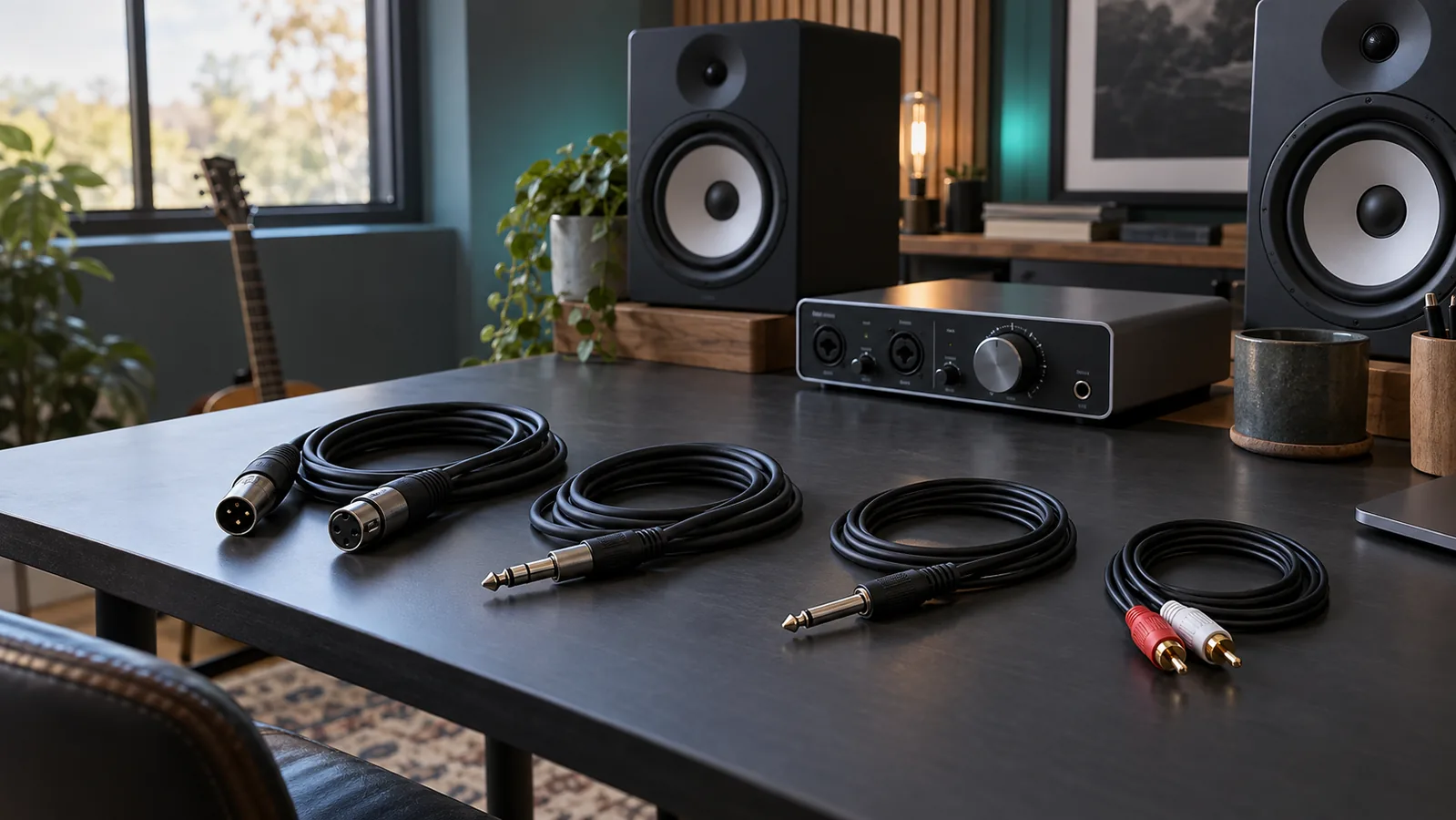
Balanced vs unbalanced audio is mainly a choice about noise control and compatibility, not a contest in which one cable always sounds better. A balanced link rejects shared interference, which is valuable for microphones, studio monitors, long runs, and electrically busy rooms. An unbalanced link is often appropriate for a short guitar, turntable, or home hi-fi connection.
Quick answer: Use a balanced connection when both the source output and destination input support it, especially for low-level signals, longer runs, or cables near power supplies, lighting, computers, and motors. Use unbalanced when the equipment requires it or a short, quiet run already works cleanly. A different plug or adapter cannot turn an unbalanced output into a true balanced source.
What “Balanced” Actually Describes
The terms describe an electrical interface, not recording quality, speaker accuracy, or whether a product is “professional.”
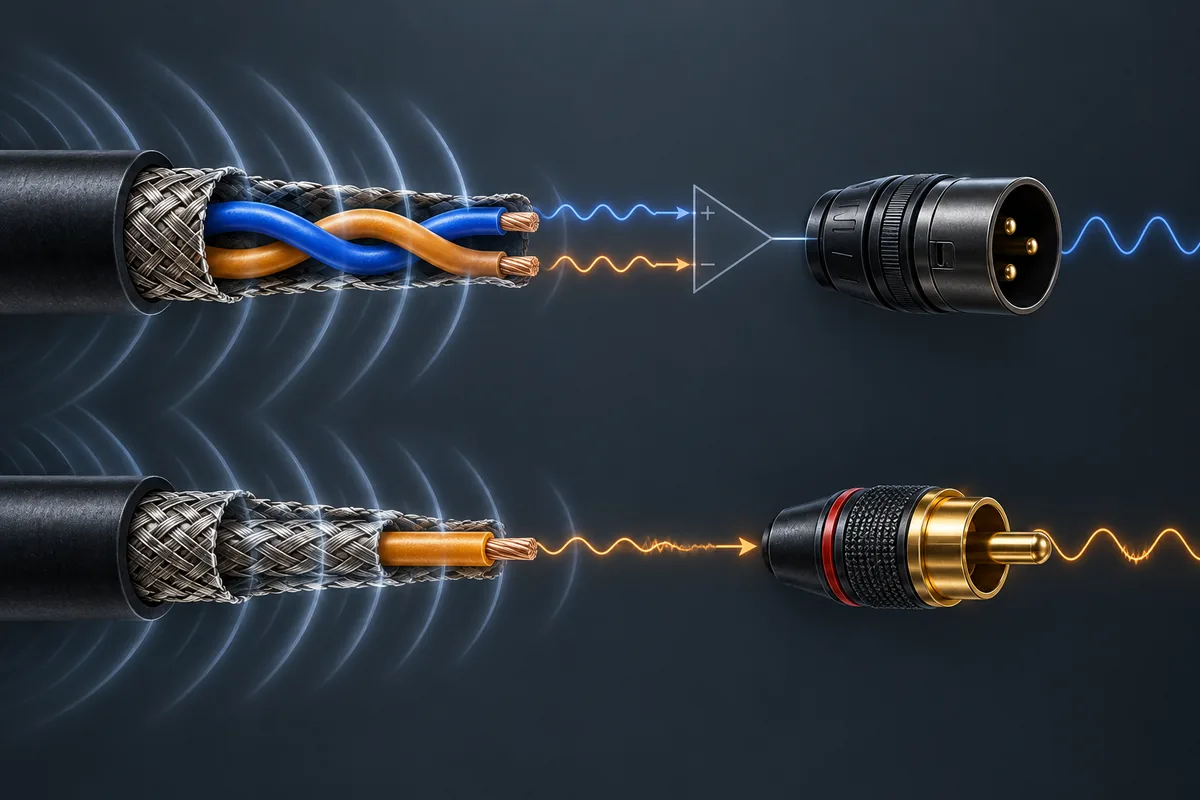
An unbalanced connection normally uses one signal conductor plus a shield or return. Unwanted voltage can reach the receiver with the audio. RCA and 1/4-inch TS connections commonly work this way.
A balanced line uses two signal conductors and usually a separate shield. The receiving input responds to the difference between the two signal conductors while rejecting voltage that appears similarly on both. That unwanted shared voltage is called common-mode noise.
Equal, opposite audio waveforms are common but not the complete definition. Noise rejection depends on closely matched impedance to ground and a differential input. Some outputs are impedance-balanced even though only one conductor carries the full signal.
Yamaha describes balanced wiring as a three-conductor system that reduces external noise, while noting it is not inherently better in every application (Yamaha).
How Common-Mode Noise Rejection Works
Imagine interference from a dimmer or power cable coupling into both conductors as the cable crosses a room. At the balanced input, the wanted difference between the conductors remains, but noise that is nearly the same on both can be cancelled.
This protection depends on the complete link:
- the source must provide an appropriate balanced or impedance-balanced output;
- the cable must maintain the intended conductor and shield arrangement;
- the destination must have a balanced differential input; and
- the two signal paths must remain closely matched.
The cable does not perform the cancellation alone. A TRS-to-XLR cable cannot balance an unbalanced output unless suitable source circuitry is present.
Balanced wiring is especially useful with low-level microphone signals that need substantial gain. Shure notes that professional microphones normally use balanced outputs for noise rejection and longer runs (Shure).
Connector Shape Does Not Prove the Signal Type
A connector tells you how many contacts are available, not necessarily how the equipment uses them. Check the labels and manual at both ends.
| Connector | Common use | Usually balanced? | Important exception |
|---|---|---|---|
| 3-pin XLR | Microphones, mixers, interfaces, powered speakers | Often | XLR can also carry unbalanced audio, digital signals, or other wiring |
| 1/4-inch TRS | Balanced mono line, stereo headphones, inserts | Sometimes | One plug may carry two unbalanced stereo channels or send/return |
| 1/4-inch TS | Guitar, bass, pedals, unbalanced line | Usually no | A TS plug in a combo socket may select a different input mode |
| RCA | Consumer line and phono connections | Usually no | Digital coaxial uses the same shape for a different signal type |
| 3.5 mm TRS | Headphones and stereo aux connections | Usually no | Its three contacts normally carry left, right, and shared return |
Focusrite, for example, specifies that its 1/4-inch interface inputs and outputs are mono balanced, while its TRS headphone outputs are unbalanced stereo (Focusrite). Identical-looking plugs can therefore serve different circuits.
Balanced vs Unbalanced Audio: The Practical Differences
| Decision factor | Balanced connection | Unbalanced connection |
|---|---|---|
| Noise rejection | Rejects common-mode interference when the full link is correctly implemented | Relies mainly on shielding and short, sensible routing |
| Typical conductors per mono channel | Two signal conductors plus shield | One signal conductor plus shield/return |
| Common connectors | XLR, 1/4-inch TRS | RCA, 1/4-inch TS |
| Best fit | Microphones, interfaces, mixers, active monitors, stage and installed audio | Guitars, pedals, many turntables, consumer hi-fi, short aux connections |
| Automatic sound-quality advantage | No; benefit may be inaudible when the unbalanced link is already quiet | No penalty simply because the link is unbalanced |
| Conversion | Requires suitable source and input circuitry | An adapter alone does not add balancing circuitry |
Cable length is a risk factor, not a universal cutoff. The result also depends on signal level, source impedance, grounding, routing, and the electrical environment. Treat fixed limits as planning shortcuts rather than laws.
An End-to-End Connection Audit
Before buying a cable, inspect the whole path in five steps.
1. Identify the signal role
Is it microphone, instrument, phono, line, headphone, or amplified speaker level? These are not interchangeable just because a plug fits. A passive guitar wants an instrument input, while a turntable may need a phono preamp. Never send a power-amplifier output into a line input.
2. Read the source output specification
Look for words such as balanced line output, impedance balanced, unbalanced, stereo headphone, or insert. Record the connector and nominal level. Do not infer the electrical type from an XLR or TRS socket alone.
3. Read the destination input specification
Confirm whether the receiving device accepts balanced, unbalanced, or both. A combo input may treat its XLR and phone contacts differently or switch among microphone, line, and instrument modes.
4. Choose the cable for those two documented endpoints
If both endpoints are balanced, use the manufacturer-supported balanced wiring. If either endpoint is unbalanced, the link is not end-to-end balanced. It may still work perfectly, but choose the cable or interface method recommended for that equipment.
5. Consider the route and environment
Prioritize balanced wiring when the cable must travel far, run beside mains wiring, cross a stage, connect equipment powered from different locations, or carry a low-level microphone signal. For a one-metre RCA link between adjacent home components with no audible hum, replacing it solely to obtain XLR connectors is unlikely to solve a real problem.
The audit leads to three decisions: keep the balanced path, use the designed unbalanced connection, or add a DI box or transformer.

Where Each Connection Makes Sense
Audio interface to powered studio monitors
Use balanced TRS or XLR when both devices support it. Computers, displays, and power supplies make a desktop studio electrically busy. Focusrite recommends balanced cables between balanced interface outputs and speaker inputs to reduce interference risk (Focusrite).
Microphone to mixer or interface
A professional microphone-to-preamp path is normally balanced XLR. The low signal will later be amplified, making cable noise conspicuous.
Guitar, bass, and pedalboard
Passive instruments and many pedals use unbalanced TS by design; a TRS cable does not balance them. For a long mixer run, a DI box can provide a suitable balanced output and instrument load.
Turntable and home hi-fi
Many turntables, phono preamps, DACs, and integrated amplifiers use short RCA connections successfully. Correct grounding and routing still matter. An XLR adapter does not replace a phono preamp or cure a ground loop.
Mixer or interface to distant stage equipment
Balanced lines are the normal choice. If legacy unbalanced gear must join the system and hum appears, use a purpose-built DI or transformer isolator recommended for the signal level. Rane’s interconnection guidance recommends transformer isolation as a dependable way to interface balanced and unbalanced equipment and warns against improvised grounding changes (Rane).
Mixed Connections: What Adapters Can and Cannot Do
A passive adapter rearranges contacts but cannot create matched impedance, a differential receiver, isolation, or level conversion.
Some balanced outputs can feed unbalanced inputs with the correct cable. Others can lose level, distort, or mute if a signal leg is grounded. Consult both manuals before using XLR-to-RCA, TRS-to-TS, or custom wiring.
Do not disconnect the protective earth pin on mains plugs to chase hum. Protective grounding is a safety system. If swapping to the documented cable, separating power and signal routing, and powering related equipment appropriately do not solve the problem, use approved audio isolation or ask a qualified technician to diagnose it.
Balanced Line Audio Is Not Balanced Headphone Drive
The word balanced also describes some 4.4 mm and 4-pin XLR headphone outputs. That differs from a balanced line between devices.
A conventional stereo headphone plug carries left, right, and a shared return. A “balanced” headphone output provides separate conductors for each driver’s terminals and may use a bridged amplifier. It can provide more voltage or avoid a shared return, but it does not reject cable noise like a balanced microphone or line connection.
Do not connect a balanced headphone output to a line input or use an adapter that shorts its negative outputs together unless the manufacturer explicitly permits it. Compare power, noise, output impedance, and compatibility for the exact amplifier; do not assume the balanced jack is automatically the cleaner-sounding one. Benchmark, for example, argues that voltage-balanced headphone drive has different tradeoffs from balanced line transmission (Benchmark).
Troubleshooting Hum, Buzz, or Radio Interference
Work from the simplest reversible checks:
- Turn levels down and confirm every cable is in the intended input and output.
- Replace one suspected cable with a known-good cable of the correct type.
- Move audio cables away from power bricks, dimmers, chargers, and mains cables; cross power cables at roughly a right angle when practical.
- Disconnect sources one at a time to identify the link that introduces the noise.
- Confirm whether the noisy link is truly balanced end to end.
- For mixed systems, use manufacturer-approved DI or isolation equipment rather than homemade ground-lift wiring.
Noise that changes with a laptop charger, display cable, or antenna feed may indicate a ground-path problem. Expensive cable cannot compensate for the wrong interface or unsafe grounding.
Frequently Asked Questions
Does balanced audio sound better?
It can sound cleaner when it prevents audible hum or interference. If a short unbalanced connection is already quiet and operating within specification, balanced wiring does not automatically add detail, dynamics, or fidelity.
Is XLR always balanced?
No. Three-pin XLR is commonly used for balanced analogue audio, but the equipment documentation determines the signal and pinout.
Is TRS always balanced?
No. A TRS plug can carry one balanced mono signal, unbalanced stereo headphones, or an insert send and return. Read the socket label and manual.
Can I connect a balanced output to an unbalanced input?
Often, but the correct cable and expected level depend on the output circuit. Use the manufacturer’s connection diagram. A transformer or active converter is preferable when isolation, impedance matching, or reliable noise control is required.
Should I replace all RCA cables with XLR?
Not unless both devices offer properly implemented balanced connections and you have a reason to change. A quiet short RCA link is already doing its job.
The Decision Rule
Choose balanced audio for an end-to-end supported path when noise exposure, low signal level, cable length, or system grounding makes its rejection useful. Choose unbalanced audio when the equipment is designed for it and the route is short and quiet. In either case, match signal role, level, impedance, connector wiring, and device instructions before focusing on cable branding.
Balanced is a tool for a defined electrical problem. Used where it belongs, it makes systems more robust. Used as a badge of quality without checking both endpoints, it becomes an expensive connector swap.