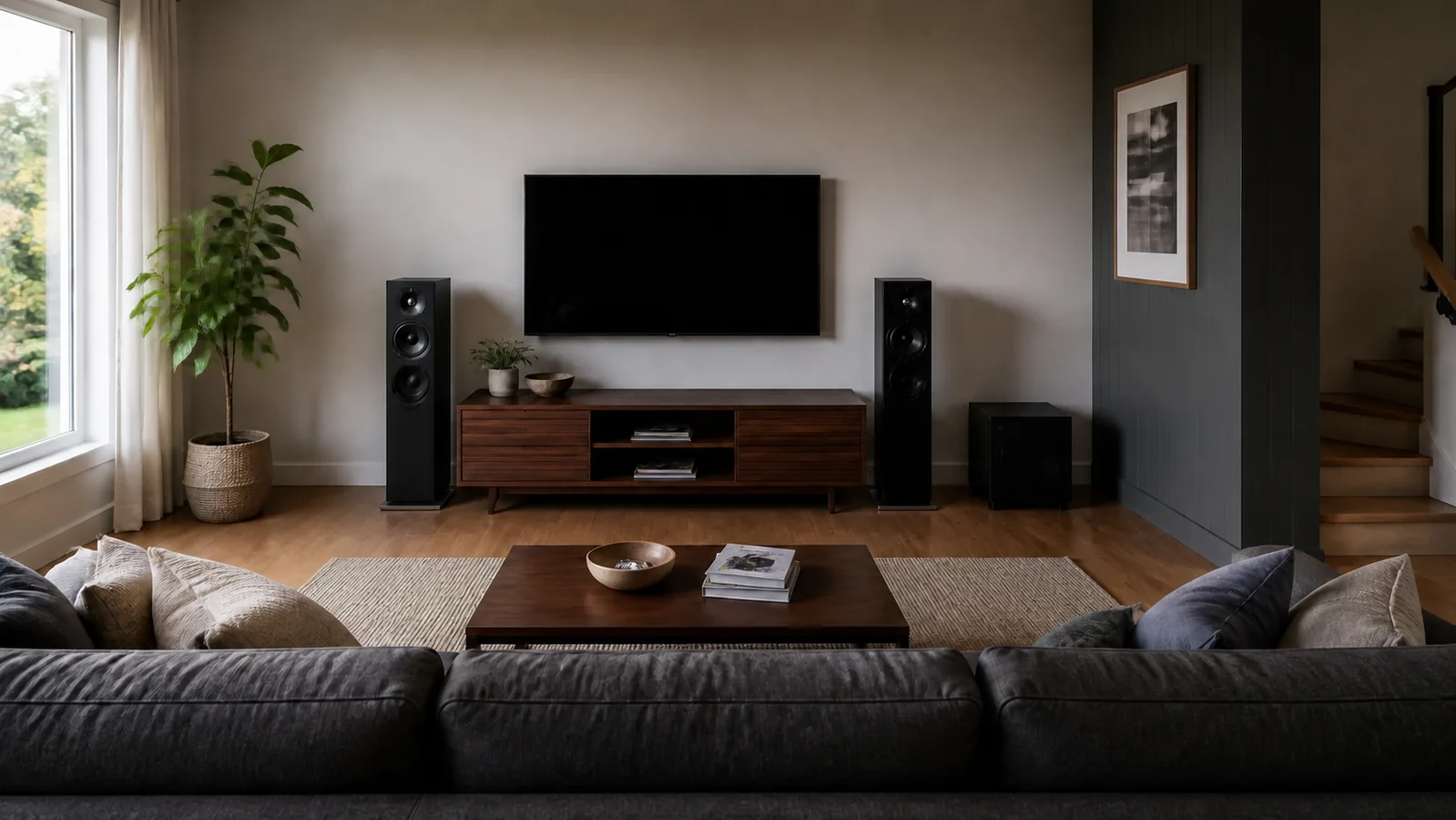
Subwoofer placement can change the bass more dramatically than replacing one competent subwoofer with another. A position that sounds powerful at one seat may produce a deep null at the next. The best spot is not a universal point on a floor plan; it is the position that gives the smoothest response across the seats that matter, followed by correct system calibration.
Quick answer: Start with the subwoofer along the front wall, slightly away from the room’s centre line. Test several practical positions, then use a subwoofer crawl or, preferably, repeatable microphone measurements at the listening area. Choose the location with the fewest severe dips and the smallest seat-to-seat variation. Calibrate only after placement is settled.
Why Subwoofer Placement Changes What You Hear
Low bass behaves differently from the directional midrange and treble produced by your main speakers. A 40 Hz wave is roughly 8.6 metres long in ordinary indoor conditions, so it interacts strongly with the room’s walls, floor, and ceiling. Reflections combine with direct sound to create standing-wave patterns called room modes.
At a modal peak, a bass note can sound much louder and linger. At a null, direct and reflected energy partly cancel, making the same note seem weak or absent. Moving the subwoofer changes which modes it excites; moving the listener changes where that person sits within the pressure pattern. Penn State acoustics demonstrations show that a source placed at a pressure antinode drives a mode strongly, while moving it toward a node reduces that mode’s response (Penn State Graduate Program in Acoustics).
This explains why “more bass” is not the same as “better bass.” The goal of bass speaker placement is usually a reasonably even response, clean integration with the main speakers, and acceptable consistency across the listening area—not the highest sound level at one frequency.
Decide What You Are Optimising
Before moving equipment, define the listening target. A single music chair allows you to optimise one position; a sofa or two-row home theatre needs a compromise across several seats.
Record three priorities:
- Reference seat: the main listening position where tonal balance matters most.
- Listening area: one chair, a sofa, or multiple rows.
- Practical limits: cable routes, door clearance, ventilation, and the manufacturer’s required clearances.
Keep the main listening seat out of the exact room centre when possible, because it may coincide with nulls for some axial modes. This is a starting hypothesis, not a rule; openings, furniture, and construction change the result.
The Best Starting Positions to Test
There is no single placement rule that wins in every room. Use a short list of plausible positions and compare them under the same conditions.
Front wall, slightly off-centre
This is a strong first candidate for a single subwoofer. Genelec recommends a position along the front wall and slightly away from the room’s middle axis in many small-room monitoring setups, while also emphasising measurement and trial (Genelec monitor placement). The location keeps the sub near the main speakers, usually simplifies cable routing, and can make timing integration easier.
Do not interpret “off-centre” as a magic fraction. Move in practical increments and measure. The best result may be near a quarter-width position, closer to a corner, or along a side wall depending on the room and seats.
Near a wall or corner
Walls and corners increase low-frequency loading, often producing more output for the same amplifier setting. That can be valuable when the subwoofer has limited headroom. The trade-off is that a boundary position may excite several modes strongly, creating uneven or boomy bass.
Corner placement is therefore a candidate, not a default. If it gives useful extension without severe peaks or seat-to-seat inconsistency, keep it. If a few notes overwhelm everything else, move the cabinet away from the corner and retest before reaching for equalisation.
Side-wall or rear-wall positions
A side or rear wall can outperform the front wall when front locations create a deep null. These positions are especially worth testing with a second subwoofer because separation can excite a different set of modes. Check delay and phase carefully.
Avoid blocking a port or placing the cabinet where furniture rattles. Follow the manufacturer’s clearance instructions; cabinet designs have different physical requirements.
How to Find the Best Subwoofer Placement
Step 1: Freeze the system settings
Use the same content, volume, crossover, polarity, and room-correction state for every comparison. Disable temporary bass boost. Bypass correction from an older layout during testing; otherwise you are comparing both position and old filters.
Mark each candidate position with painter’s tape and give it a simple label. Record the subwoofer orientation and distance from nearby boundaries so that a promising result can be reproduced.
Step 2: Use the subwoofer crawl for a fast shortlist
Place the subwoofer at the main listening position, approximately where the listener’s head or torso would be. Play a repeating bass sweep or a sequence of low-frequency tones at a moderate level. Move around the practical subwoofer locations and listen for bass that is even rather than merely loud.
This technique uses acoustic reciprocity: swapping the source and receiver positions preserves the relevant transfer relationship. Genelec describes a measurement-based version in which the subwoofer sits at the listening position while a microphone is moved among possible subwoofer locations (Genelec Support, updated 2020).
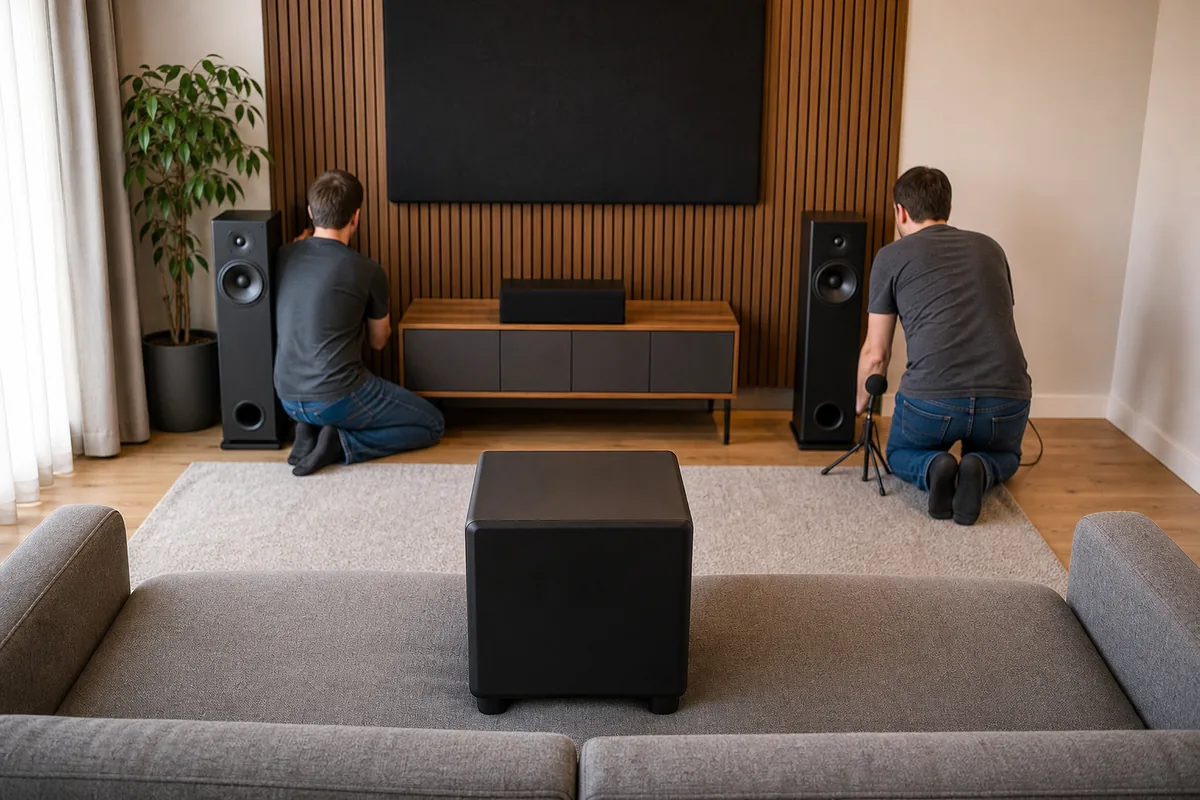
*The reciprocity setup makes it easier to test positions around the room. AI-generated conceptual scene.*
The crawl is useful for eliminating bad positions, but ears adapt quickly and steady tones can exaggerate the appeal of a loud peak. Keep two or three finalists for measurement instead of declaring the loudest location the winner.
Step 3: Measure each finalist
A calibrated measurement microphone and acoustic software provide the clearest comparison. Place the microphone at ear height, keep its orientation consistent, and run the same sweep for every candidate. Measure the main seat first, then repeat at nearby seats or positions across the sofa.
Compare the frequency range covered by the subwoofer and the crossover region. Look for:
- deep, narrow nulls that are difficult to correct electronically;
- broad peaks that make several bass notes sound heavy;
- a smooth transition between subwoofer and main speakers;
- similar response across the seats that matter;
- excessive ringing or slow decay at particular frequencies.
Use identical graph limits and smoothing for every measurement, and listen to familiar content after the comparison. The winner is the best overall compromise, not the graph with the highest average level.
Step 4: Integrate crossover, phase, delay, and level
Placement comes first; integration comes next. Set the crossover according to the capabilities of the main speakers, subwoofer, and processor rather than copying a universal number. Then align phase or delay around the crossover region. Genelec notes that misalignment can reduce output at the crossover and recommends adjusting phase after the monitors and subwoofer are in their final positions (Genelec phase guidance).
Re-measure the subwoofer alone, mains alone, and both together when your system permits it. If the combined response falls below either component near the crossover, polarity, phase, delay, or filter interaction needs attention. Finally, match level by measurement and listening; a subwoofer that constantly calls attention to itself is often too loud, poorly integrated, or exciting a strong mode.
Step 5: Apply room correction last
Automatic room correction can reduce some peaks and align levels and timing, but equalisation does not reliably repair a severe cancellation (Genelec monitor placement). Moving the sub or listener is usually more effective for a deep null. Run calibration only after the cabinet, seating, and major furniture are fixed, then verify the result with a fresh measurement.
What Your Bass Problem Usually Means
| What you hear or measure | Likely cause | Placement test | Next action |
|---|---|---|---|
| One or two notes sound boomy | Strong modal peak or boundary loading | Move away from the corner or test a different wall | Re-measure, then use modest peak correction if needed |
| Bass nearly disappears at the main seat | Listener or subwoofer sits near a modal null | Move the sub, then test the seat slightly forward or backward | Keep the position that removes the deepest cancellation |
| Centre seat sounds good, sofa ends sound different | High seat-to-seat variation | Measure left, centre, and right seats | Optimise for the listening area or consider a second subwoofer |
| Bass is strong but seems detached from the mains | Level, crossover, phase, delay, or localisation issue | Compare mains-only, sub-only, and combined response | Recalibrate integration controls after placement |
| Bass changes after a door opens or furniture moves | Room boundary or damping changed | Repeat the same sweep in both conditions | Choose the normal-use condition and calibrate for it |
This table is a diagnostic starting point, not a remote diagnosis. Cabinet faults, loose objects, limiter behaviour, or unsuitable crossover settings can resemble room problems.
One Subwoofer or Two?
A second subwoofer is most valuable when you need consistent bass across more than one seat. It is not simply a way to make the system louder. Two subs in separated positions can excite room modes differently, so one unit’s response may partly compensate for another’s spatial variation.
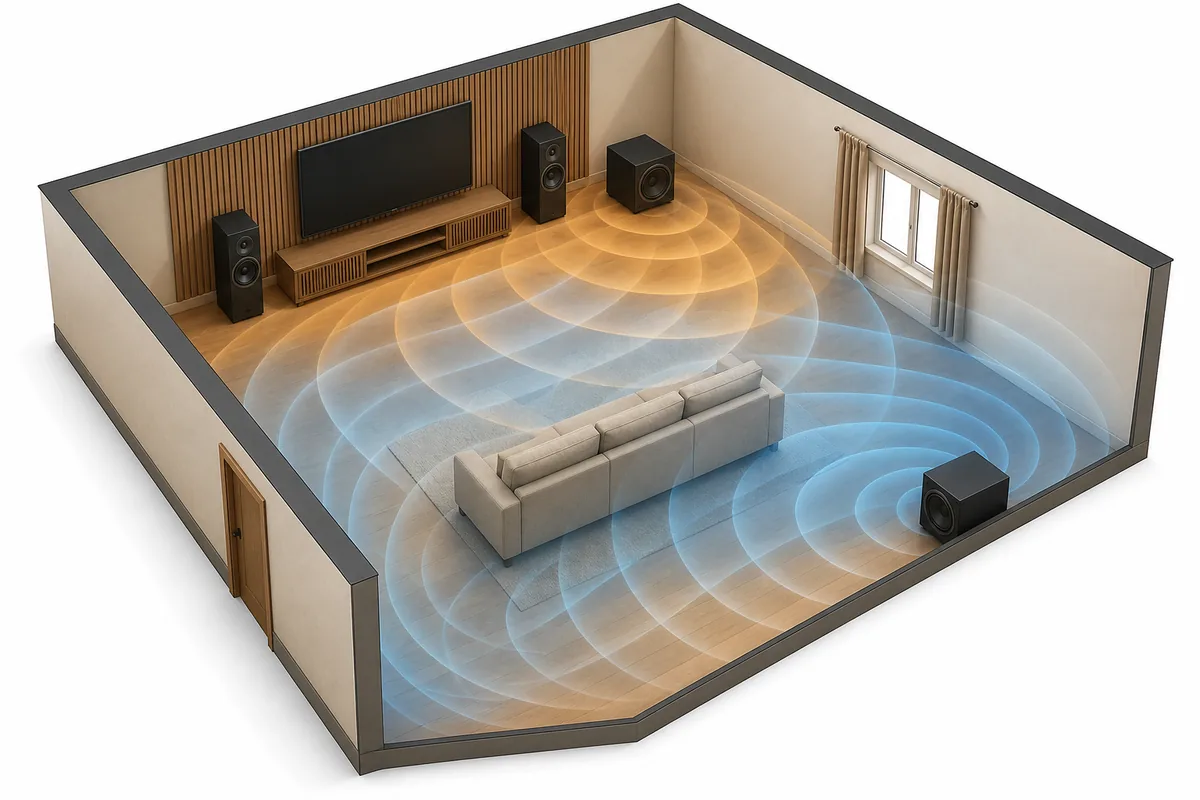
*Separated sources can be tested for better multi-seat consistency. AI-generated conceptual illustration; not to scale.*
Research by Todd Welti and Allan Devantier found that multiple-subwoofer arrangements can significantly reduce seat-to-seat low-frequency variation, making later equalisation more effective across a listening area (Audio Engineering Society, 2006). The result does not mean that any two positions will work. A later AES study cautioned that simple geometric placement rules are reliable mainly in symmetrical cases; arbitrary rooms still benefit from modal analysis or measurement (Audio Engineering Society, 2011).
For two subs, test practical pairs such as opposite wall midpoints, diagonal corners, or separated front-wall positions. Measure each sub independently before combining them. If the processor supports independent delay and level control, preserve separate channels rather than treating both cabinets as one uncontrolled source.
Common Subwoofer Placement Mistakes
- Choosing the loudest spot by ear. A strong peak sounds impressive for a minute but makes bass lines uneven. Choose smoothness and consistency instead.
- Running room correction before moving the cabinet. Filters then compensate for a position you may abandon. Finalise placement first.
- Trying to boost a deep null. Cancellation can consume amplifier and driver headroom without restoring the missing bass. Change geometry before applying boost.
- Testing only one seat. This is acceptable for a dedicated listening chair, but not for a family sofa or theatre row.
- Changing several variables at once. Moving the sub while changing phase, crossover, and level makes comparisons meaningless.
- Assuming low bass is completely non-directional. Very low frequencies are difficult to localise, but distortion, port noise, vibration, and crossover content can reveal the cabinet’s position.
- Ignoring physical noise. A technically flat response is not useful if the subwoofer makes a cabinet door, floor panel, or nearby object rattle.
FAQ
Should a subwoofer face the wall?
It can, provided the manufacturer allows that orientation and the driver or port has the specified clearance. At typical subwoofer frequencies, the room position usually matters more than the direction the cone faces. Still, a rear port placed too close to a boundary or a driver aimed into an obstruction can create airflow noise or mechanical problems, so check the product manual.
Is a corner always the best place for a subwoofer?
No. A corner often provides the most boundary reinforcement and usable output, but it may also excite room modes strongly. Test the corner against at least two other locations. Keep it only if measurements and listening show acceptably smooth bass across the intended seats.
Can I put a subwoofer behind the sofa?
Yes. Near-field placement behind a sofa can provide strong tactile impact and may reduce the output needed for the main seat. It can also make localisation, delay, and seat-to-seat differences more obvious. Measure the crossover region and check every important seat before committing to it.
Do bass traps replace good subwoofer placement?
No. Placement controls how the source excites room modes; bass trapping reduces the energy and decay of low-frequency resonances. The methods are complementary. In small rooms, effective deep-bass treatment can be physically large, so start with subwoofer and listener position, then add suitable treatment and calibration.
Conclusion
The best subwoofer placement is the location that produces the smoothest response and the smallest unacceptable differences across your real listening area. Begin with sensible wall positions, use the subwoofer crawl to shortlist candidates, and confirm the result with consistent measurements. Only then set crossover, phase, delay, level, and room correction. If a single sub cannot serve several seats, a properly measured second subwoofer can improve uniformity more effectively than simply buying a larger single unit.
Sources
- Daniel A. Russell, Penn State Graduate Program in Acoustics. “Driving Room Modes: Source Location.” https://www.acs.psu.edu/drussell/Demos/roommodes/driving.html
- Genelec. “How to Place Your Monitors?” https://www.genelec.com/monitor-placement
- Genelec Support. “Where Is the Best Place to Position the Subwoofer in a Room?” Updated April 28, 2020. https://support.genelec.com/hc/en-us/articles/360013406119-Where-is-the-best-place-to-position-the-subwoofer-in-a-room
- Genelec Support. “How Does the Subwoofer Test Tone Work?” Updated April 28, 2020. https://support.genelec.com/hc/en-us/articles/360013408939-How-does-the-subwoofer-test-tone-work
- Todd Welti and Allan Devantier. “Low-Frequency Optimization Using Multiple Subwoofers.” Journal of the Audio Engineering Society, May 2006. https://aes2.org/publications/elibrary-page/?id=13680
- Juha Backman. “Subwoofers in Rooms: Modal Analysis for Loudspeaker Placement.” Audio Engineering Society Convention Paper 8323, May 2011. https://aes2.org/publications/elibrary-page/?id=15790