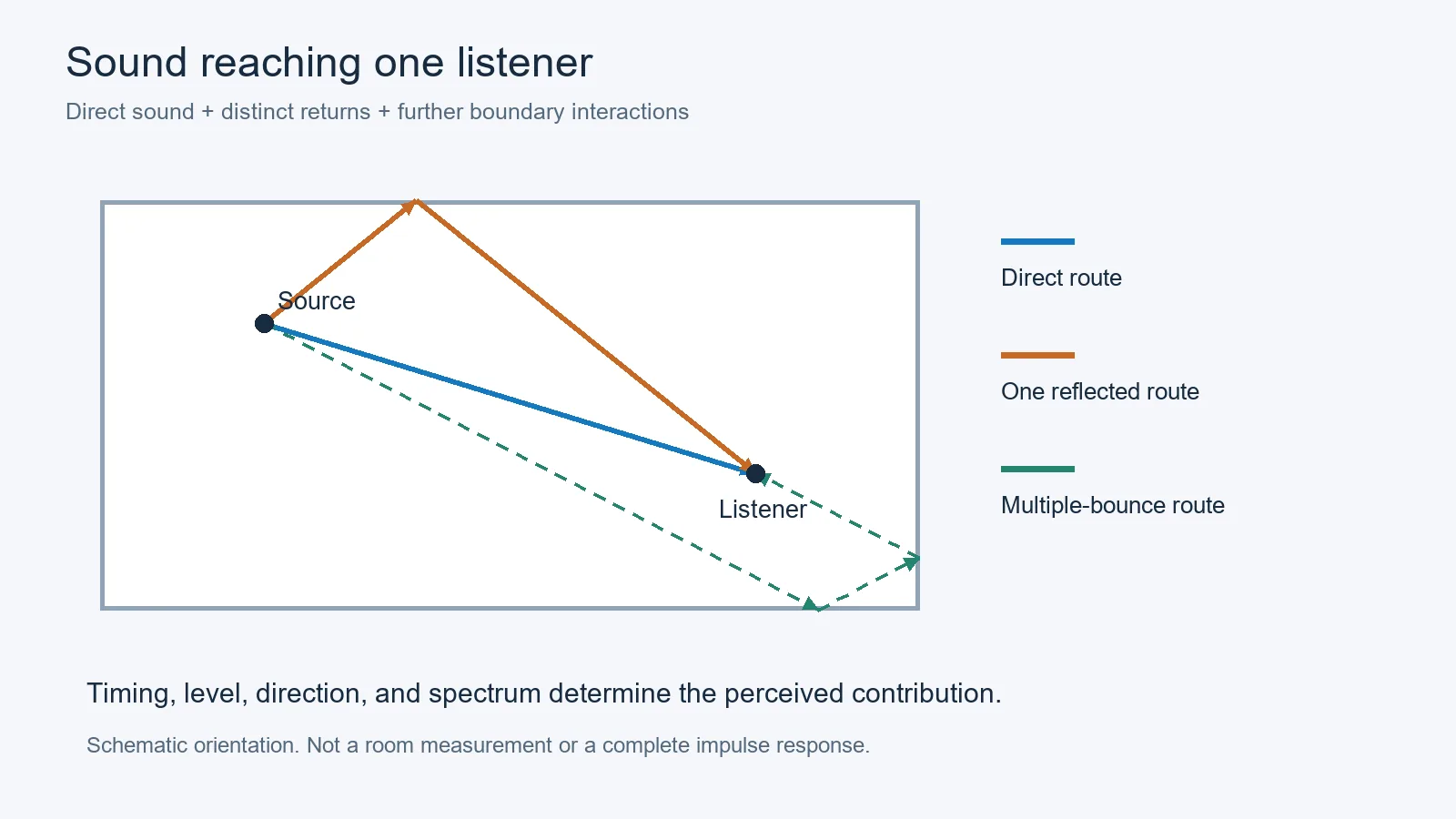
Sound reflections are sound waves returning into a room after meeting a surface. You hear them alongside the direct sound from a speaker, voice, or instrument. They can add welcome spaciousness, but strong or poorly distributed reflections can obscure speech, change tonal balance, and make stereo images less precise.
The useful question is not “How do I remove every reflection?” It is “Which arrival is affecting this listening task, and what would confirm it?” This guide connects the physics to practical tests, without treating every room problem as an excuse to buy panels.
How sound reflections form at a surface
Incident sound energy can be reflected, absorbed, or transmitted through a boundary. An acoustic reflection is the returned part, not a separate kind of sound. Real surfaces usually combine these behaviors. Absorption dissipates energy; scattering changes the directions of reflected energy. Transmission carries energy beyond the boundary rather than returning it to the room.
A large, smooth surface produces a predominantly specular reflection: the reflected angle equals the incident angle, measured from the surface normal—the perpendicular line, not the wall itself. Diffuse reflection distributes energy across directions. Roughness is relative to wavelength: a texture that scatters treble may look effectively smooth to bass. ETH’s room-acoustics teaching material explains this ray-versus-wave distinction.
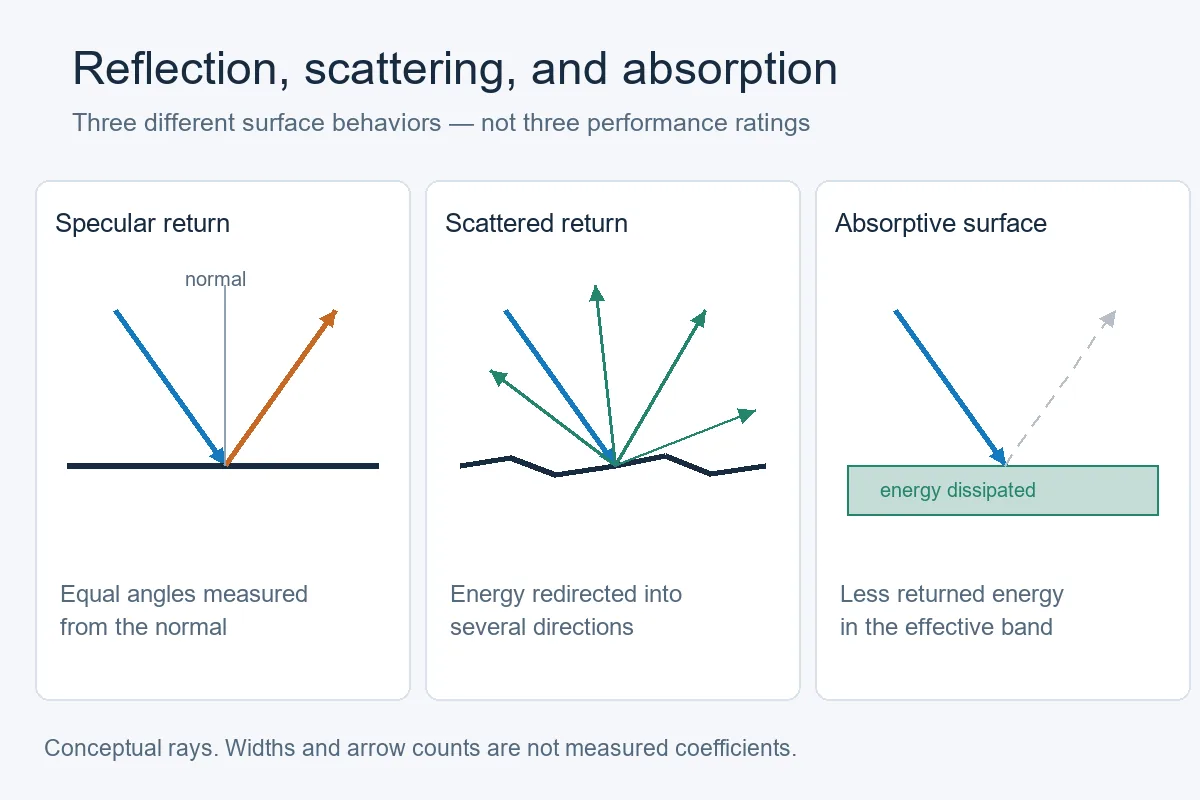
Glass, masonry, painted walls, and furniture do not have one universal “reflectivity.” Their construction, backing, vibration, frequency, and incidence angle matter. Curved geometry may concentrate energy; irregular geometry may redirect it. A bookshelf may scatter some sound without behaving like a tested diffuser.
The pressure reflection coefficient describes reflected pressure relative to incident pressure, including phase. An energy reflection coefficient describes reflected power, not pressure amplitude. These are not interchangeable percentages. Fidecki’s university-hosted acoustics text also emphasizes frequency and angle dependence. A single coefficient cannot predict everything heard at a seat.
Direct, early, and late sound do different jobs
Direct sound follows the unobstructed source-to-listener route. Early reflections are the first distinct returned arrivals, often involving nearby walls, a floor, ceiling, desk, or window. Late reflections accumulate after further interactions; their overlapping tail contributes to reverberation.
These descriptions are useful, but there is no universal millisecond boundary separating helpful sound from harmful sound. Signal type, reflection level, direction, spectrum, and the room all affect perception. Metric-specific time windows are conventions, not universal echo thresholds.
Early lateral energy can broaden the apparent source; later lateral energy can contribute to envelopment. That does not make every side-wall reflection desirable for mixing or precise stereo localization. The same spaciousness valued in recreational listening may complicate judging a recording. Fidecki’s text distinguishes these spatial effects rather than equating all reflected energy with damage.
For monitoring, clarity and repeatability usually take priority. For a living room or recording room, a controlled room contribution may be welcome. Define the use before deciding how dry the space should become.
From a reflection path to an audible effect
A delayed reflection combines with direct sound at the listener. Their pressure phases can reinforce some frequencies and cancel others, producing a comb-like response. James Angus’s Institute of Acoustics paper models how reflection delay and surface behavior influence frequency response and stereo imaging. A jagged microphone trace alone does not establish the perceptual importance of every dip.
Consider a hypothetical, same-height source and listener viewed from above. The wall is at x=0; the source is at (1,1) meters and the listener at (2,3). Reflecting the source across the wall gives a virtual source at (−1,1). That geometry locates the bounce at (0,1.67).
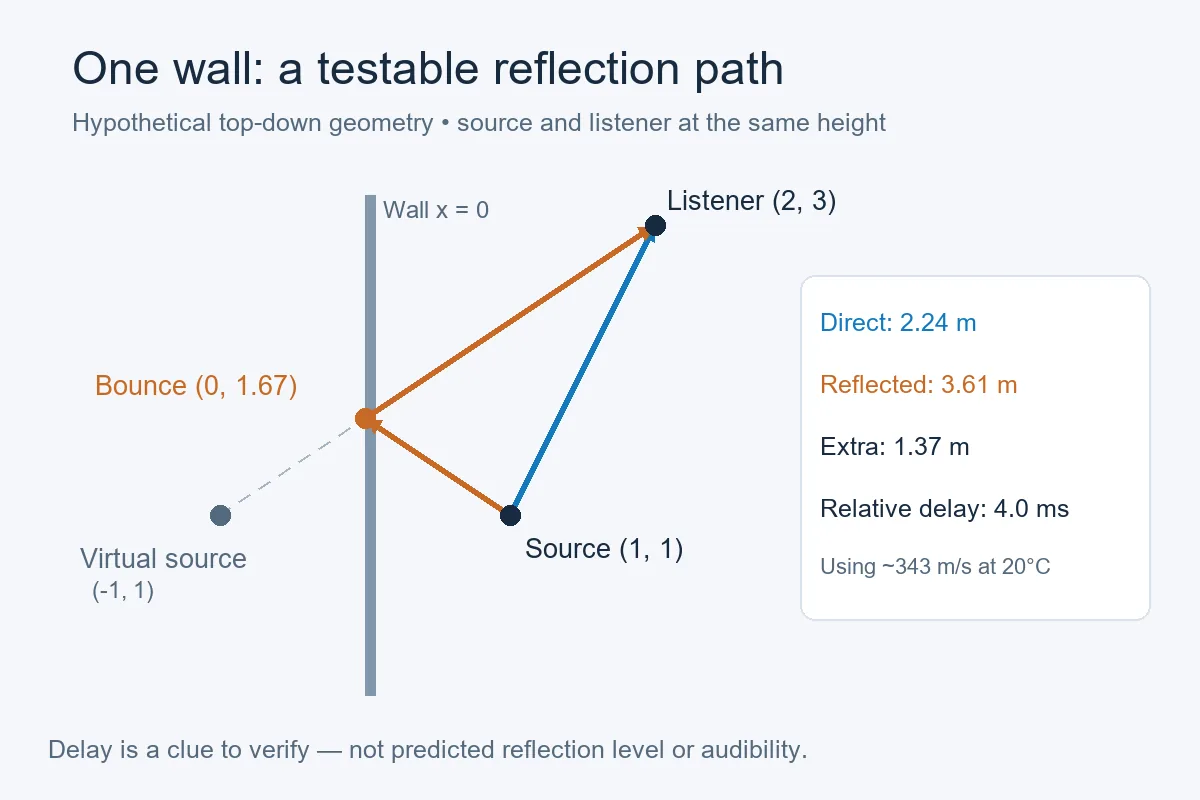
The direct route is √5 ≈ 2.24 m; the reflected route is √13 ≈ 3.61 m. Using approximately 343 m/s at 20°C, the additional 1.37 m gives about 4.0 milliseconds of delay relative to direct sound.
This produces a testable hypothesis: inspect the measured impulse response near that relative arrival, then temporarily cover the candidate wall zone with suitable absorption and repeat. If the arrival weakens and the listening complaint improves, the hypothesis gains support. Geometry cannot predict its actual level, guarantee audible improvement, or prove that other surfaces are unimportant.
Separate reflection artifacts before choosing a remedy
Several effects can coexist, but their mechanisms differ:
- Early-reflection interference: direct and delayed sound combine, affecting response or image precision.
- Flutter echo: repeated returns between facing reflective surfaces produce rapid, often metallic repetition.
- Slap echo: a conspicuous discrete return follows a transient or speech sound, rather than merging into a smooth tail.
- Reverberation: many overlapping returns continue after the source stops.
- Room modes: resonant spatial patterns produce frequency-specific pressure variations and decay, especially conspicuous in small-room bass.
- SBIR: speaker-boundary interference response arises when boundary-reflected sound interferes with speaker output at the listener.
Genelec’s room-acoustics guidance describes boundary cancellation and its dependence on placement. SBIR and modes can overlap; neither can be identified reliably by calling bass “echoey.” Equipment response, crossover errors, rattles, and channel imbalance also deserve investigation.
Use the room mode calculator guide for predicted resonances, not for locating a particular early-reflection ray. Use the subwoofer placement guide when the complaint is bass variation or integration rather than speech-band reflection.
Turn a listening complaint into a test
The table is a diagnostic shortlist, not a remote verdict. Check one mechanism before selecting permanent treatment. On small screens, scroll the table horizontally.
| Problem | Likely cause | Identification method | Treatment to test | Limitation |
|---|---|---|---|---|
| Center image feels unstable | Unequal early paths or channel geometry | Mono voice; separate left/right measurements; compare surroundings | Matched placement and targeted broadband absorption | Also check level, polarity, speaker behavior, and recording |
| Metallic repetition after a clap | Flutter between facing surfaces | Clap at several positions; temporarily cover a suspect surface | Absorption or appropriate scattering that interrupts the path | A clean clap does not prove good bass or imaging |
| One obvious delayed repeat | Strong isolated return, often from a distant boundary | Impulse-response arrival and plausible path-length comparison | Treat or redirect the responsible return | Background noise and multiple paths can mask identification |
| Speech lingers and overlaps | Excessive reflected tail for the task | Speech playback; frequency-band decay comparison | Distributed absorption matched to affected bands | Quieting the tail will not remove external noise |
| Desk or window makes one side harsh | Strong spectrally uneven early return | Reversible position or covering test, one channel at a time | Reduce the path or add suitable absorption | Thin fabric may change treble only |
| Bass vanishes or rings at certain seats | Modes, SBIR, or integration | Response plus decay at multiple positions; isolate sources | Position changes, integration checks, then justified bass treatment | Ordinary reflection panels do not reliably fill deep nulls |
Record the complaint in specific language: “the mono voice shifts when I lean right” is more useful than “the room sounds bad.” Note whether the issue follows the seat, one speaker, one recording, or the room configuration.
Finding first reflection points—and what the mirror misses
With speakers and seating fixed, sit normally while another person moves a mirror flat along a side wall. Mark candidate zones where either speaker becomes visible. Repeat for both speakers and relevant surfaces. Revel’s Performa3 manual describes this geometric method.
The mirror identifies a possible specular path, not its strength, useful treatment bandwidth, or required panel area. Normal head movement and multiple seats produce multiple paths. Wave behavior, scattering, finite surface size, and loudspeaker directivity limit the optical analogy. Treat the marks as zones to investigate, not mandatory panel-buying locations.
In small stereo rooms, side-wall asymmetry is worth checking. In home theaters, include the center channel and important seats. Studios also need scrutiny of desks and consoles. Living rooms may have glass on one side and an opening on the other; offices may have ceiling and tabletop returns affecting speech or microphones. Furnishings change the paths, so test the normal-use configuration.
For position adjustments beyond this path-identification exercise, continue with the speaker placement guide.
Match the treatment to the energy you need to change
Broadband absorbers reduce returned energy within their effective range. Thickness, material properties, air space, coverage, and mounting affect that range. Thin carpet, curtains, or foam can soften upper-frequency returns while leaving lower-frequency problems. Sofas add absorption; tables and shelving may introduce or scatter paths. Furnishing is useful, but not a calibrated treatment specification.
Diffusers redistribute reflected energy rather than simply absorbing it. Their useful frequency range, orientation, and listener distance matter. Small rooms with short paths often need significant unwanted energy reduced before diffusion becomes a useful refinement. The diffuser versus absorber comparison covers that choice in detail.
Absorption coefficient, scattering coefficient, and directional diffusion coefficient describe different properties. ASTM’s absorption test overview uses reverberation-room decay measurements. ISO’s diffusion standard preview distinguishes the amount of scattering from its directional uniformity. Compare frequency-band data and tested assemblies; an absorption rating cannot establish diffusion quality.
Bass traps address low-frequency energy using sufficient porous depth or resonant mechanisms. They are not interchangeable with shallow reflection-control panels. Their deployment belongs on the bass-trapping decision path, supported by response and decay measurements.
None of these choices is equivalent to soundproofing. GIK’s treatment/isolation explanation distinguishes changing sound inside a room from limiting transmission between spaces. Reducing reflections does not establish a wall’s isolation performance.
A repeatable reflection-control workflow
- Identify the task and complaint. Choose speech clarity, image focus, recording coloration, or another observable outcome.
- Map plausible paths. Sketch surfaces and source/receiver positions; use mirror zones and path lengths as clues.
- Evaluate geometry first. Test one practical speaker or listener adjustment. Keep manufacturer clearances and compare the same content.
- Try the appropriate mechanism. Temporarily reduce a suspected return, or test qualified scattering where preserving energy is appropriate. Do not change every surface simultaneously.
- Verify the same condition. Match playback level, channel, microphone position, room state, and measurement settings. Compare the targeted arrival and listening outcome.
- Refine or reject the hypothesis. Retain a repeatable benefit; otherwise reconsider the path, frequency range, or cause before adding treatment.
Room EQ Wizard’s impulse-response documentation explains why arrival information helps evaluate treatment. An energy-time curve can expose returned energy, but a peak does not identify its wall automatically. Filtering and time reference affect interpretation; compare settings consistently.
RT60 describes a 60 dB decay in an appropriate diffuse-field context; T20 and T30 estimate it from shorter decay ranges. REW’s RT60 guidance warns against treating domestic low-frequency modal decay as a meaningful diffuse-field RT60. Use waterfalls or spectrograms for bass ringing instead. One average decay number cannot describe individual reflections, imaging, or every seat.
Control the unwanted contribution, not every reflection
Good reflection management connects a specific complaint to a plausible path, an appropriate treatment mechanism, and a repeatable verification. Preserve useful spatial energy when it suits the task; reduce returns that demonstrably interfere. For choosing and evaluating physical assemblies after diagnosis, continue with the acoustic treatment panels guide.
Sources
Sources linked at the relevant claims include ETH Architectural Acoustics (FS23 teaching material); James Angus, Institute of Acoustics proceedings (1998); Tadeusz Fidecki’s university-hosted acoustics text (date not stated); Genelec and Revel technical guidance (dates not stated); Room EQ Wizard official documentation; ASTM C423 overview; ISO 17497-2:2012 preview; and GIK’s treatment/isolation explanation. All accessed October 9, 2026. The geometric example is an original hypothetical calculation, not a test result.