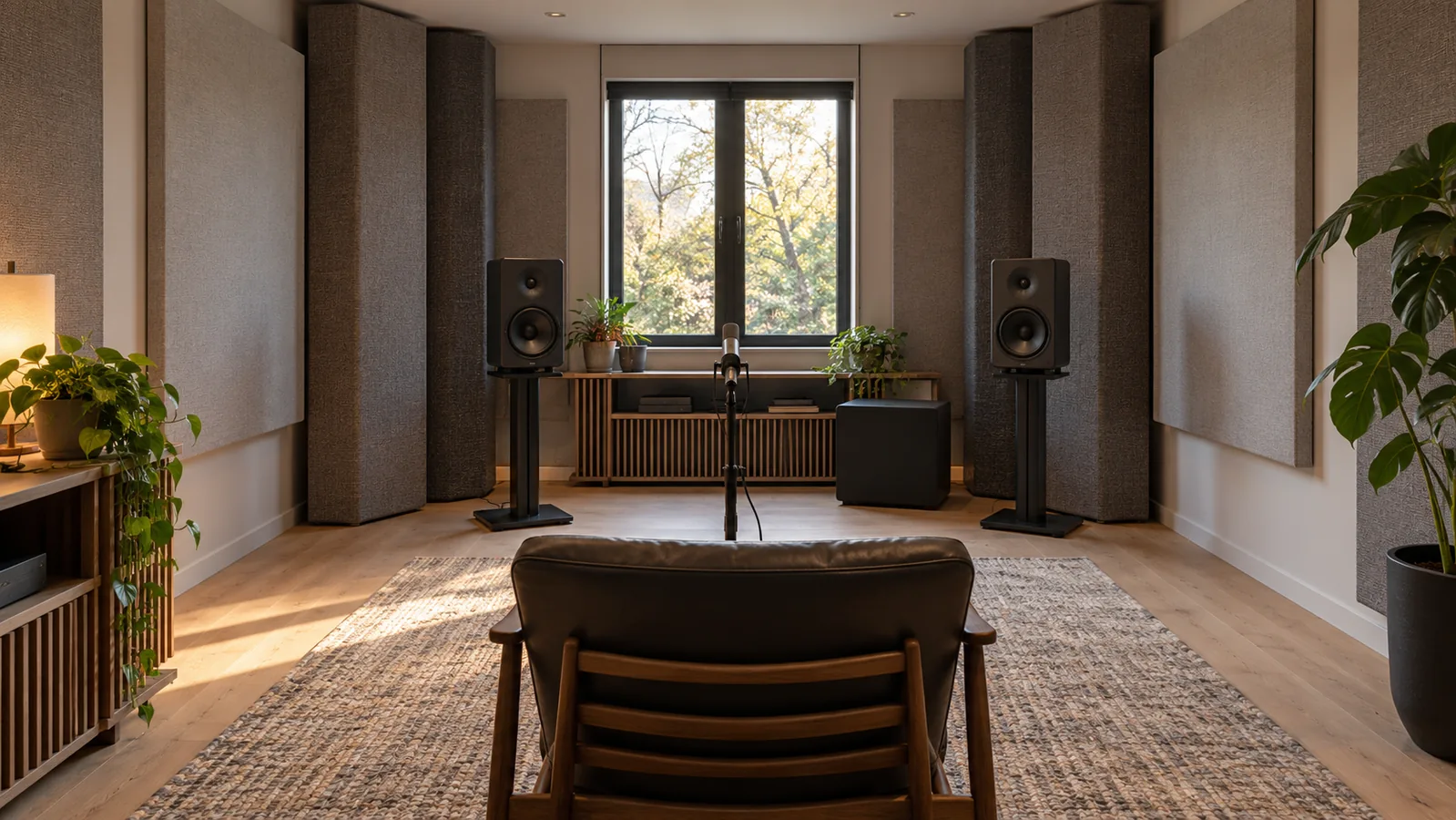
Bass traps are low-frequency acoustic treatments used to reduce resonant energy and shorten excessive bass decay inside a room. Good bass trapping can make peaks less dominant, notes more even, and kick drums or effects easier to distinguish. It is not a universal cure for every dip in a frequency-response graph.
The practical order matters: measure the room, improve speaker, subwoofer, and listening positions, then place treatment where the remaining low-frequency problem can actually interact with it. Corners are often efficient starting locations, but “put four traps in four corners” is a heuristic—not a diagnosis.
Why bass is harder to control than midrange and treble
Low frequencies have long wavelengths. In a small enclosed room, reflections between boundaries combine into room modes: stable patterns with pressure maxima and minima at different positions. The same 60 Hz note may be loud at the rear wall, weak at the sofa, and different again one seat away. Boundaries also change a loudspeaker’s radiation and can create cancellations when reflected and direct sound meet out of phase.
These problems are both spatial and time-based. A frequency-response peak shows excess level at the microphone, while a waterfall or spectrogram can reveal energy that continues after the source has stopped. Room EQ Wizard’s measurement primer describes modal resonances as slowly decaying ridges in a waterfall plot. That is why a bass-treatment decision should consider response, decay, and seat-to-seat variation together.
A room mode calculator can predict frequencies worth investigating in an approximately rectangular room. It cannot include every door, opening, wall construction, furnishing, loudspeaker, or listening position, so predictions need verification.
What bass traps actually change
A bass trap dissipates some acoustic energy instead of allowing it to keep circulating between room boundaries. In a useful installation, that can:
- reduce the prominence of modal peaks;
- shorten ringing or decay around problem frequencies;
- make bass changes between nearby seats less extreme; and
- improve the audibility of pitch, timing, and low-level detail.
Results depend on surface area, depth, mechanism, mounting, and whether the absorber works in the troublesome frequency range. A panel that absorbs well at 500 Hz is not automatically effective at 50 Hz.
Deep nulls require different expectations. When direct and reflected sound cancel at the listening position, adding absorption may weaken the reflection and help, but a severe geometric or phase cancellation usually cannot be “filled” simply by adding more porous material or EQ boost. Moving the source or listener, changing crossover and phase, or using multiple subwoofers may produce a larger improvement.
Porous, membrane, and tuned bass traps compared
“Bass trap” describes a job, not one construction. The main categories interact with sound differently.
| Type | How it works | Best fit | Important limitation |
|---|---|---|---|
| Deep porous absorber | Air motion through fibrous or open-cell material is converted into a small amount of heat through friction | Broad problems across bass and lower midrange; corners, large boundary areas, and thick rear-wall treatment | Low-frequency reach depends on depth, air gap, material properties, and mounting; a thin panel is not deep-bass treatment |
| Membrane or panel absorber | A flexible or rigid face and enclosed air cavity form a pressure-reactive system, usually with damping inside | A measured, persistent band where broadband treatment would be too bulky | Tuning, damping, sealing, and construction tolerances matter; performance is narrower and harder to predict without test data |
| Helmholtz, perforated, or slotted resonator | An opening or neck and cavity resonate, dissipating energy around a designed band | A specific identified resonance in a stable room layout | Normally narrowband and design-sensitive; an incorrect target or placement wastes space |
| Hybrid low-frequency absorber | Combines porous material with a membrane, plate, slats, or perforated face | When low-frequency control is needed but some upper-frequency reflection or scattering should remain | Labels vary widely; verify independent or manufacturer test data and the tested mounting |
Porous absorbers are velocity-based: they work where air particles move through the material. More depth and a suitable air space can extend useful absorption lower, but density alone is not a simple “more is better” control. Flow resistivity, fibre structure, thickness, coverage, and the cavity behind the panel all interact.
Membrane and resonant absorbers respond primarily to pressure and are commonly mounted at boundaries where modal pressure is high. They can solve a narrower problem with less exposed depth, but they are not a safe choice based only on a room-mode prediction. The BBC’s historical work on membrane-type low-frequency absorbers shows that resonance and damping affect acoustic impedance, reinforcing why these devices need measured or validated designs.
When comparing products, look for absorption data that extends into the frequency range you need and note the mounting method. A single NRC value mainly summarizes selected mid-frequency absorption and does not prove deep-bass performance. Laboratory data is useful, but a small-room result still depends on placement and coverage.
Bass traps placement: where to start and why
Vertical wall-to-wall corners
Corners are efficient candidates because several boundaries meet and modal pressure is often high there. Straddling a vertical corner with a deep porous panel also creates a substantial air cavity behind the material, placing part of the absorber away from the wall where particle velocity can be greater. Those are two different reasons—pressure distribution and porous-absorber geometry—and should not be confused.
Front corners are convenient in many studios and listening rooms, while rear corners may be stronger for a particular mode or source position. Treating floor to ceiling increases area, but two front corners are not automatically more important than every other boundary. A door, open stairwell, non-rigid wall, or asymmetrical subwoofer position can change the priority.
Wall-to-ceiling edges and trihedral corners
Horizontal wall-ceiling junctions can provide long, uninterrupted treatment area when floor space is scarce. The trihedral corners where three surfaces meet are common pressure hot spots. These locations are often practical for broadband traps, but the mounting must be structurally appropriate and must not obstruct ventilation, sprinklers, doors, or electrical equipment.
Front and rear wall boundaries
Large, deep treatment on the front or rear wall can address modes along the room’s length and reflections associated with the source and listener. A rear wall close to the seat is frequently a strong candidate because reflected bass returns quickly and pressure may be high near the boundary. However, first measure whether the dominant problem changes when the seat moves; a different seat position may be the higher-value first step.
Speaker and subwoofer boundary zones
Treatment behind a speaker or subwoofer can reduce some boundary-reflection energy, but it must be effective at the cancellation frequency. A decorative shallow panel cannot solve a deep SBIR null. Before allocating a large volume of treatment, follow a controlled speaker placement or subwoofer placement test to see whether a small move changes the problem substantially.
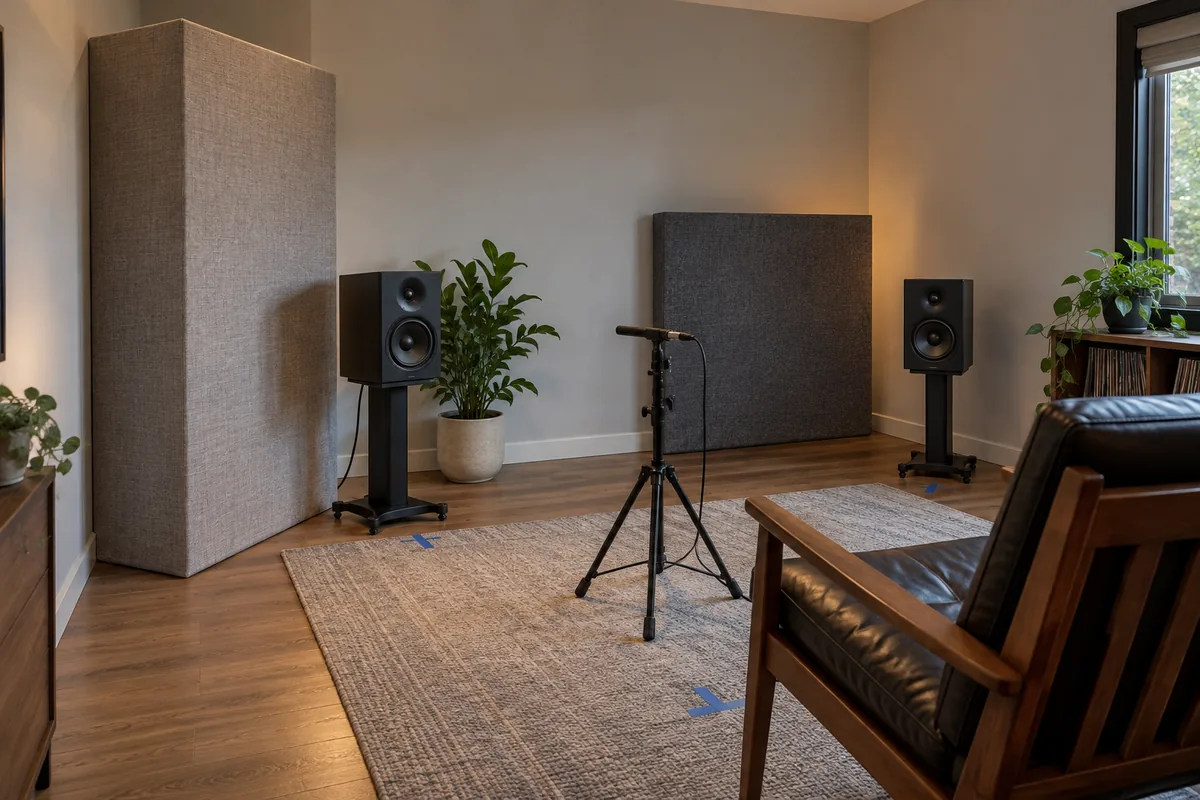
Corners are useful candidates, but measurement determines which boundaries deserve the available treatment volume.
A measurement-first bass trapping workflow
- Record the room and system. Measure length, width, and height; note openings, lightweight partitions, large furniture, speaker and subwoofer positions, crossover settings, and the listening area.
- Measure the baseline. Keep microphone position and playback level repeatable. Measure each main speaker, each subwoofer, and useful combinations. Check frequency response plus waterfall or spectrogram decay, not just one smoothed curve.
- Identify repeatable problem bands. Compare peaks and nulls with predicted modes, then move the microphone a short distance. A large positional change suggests a spatial cancellation or mode rather than a simple level error.
- Optimize source and listener positions first. Move the seat, speakers, or subwoofers in controlled increments. Recheck crossover, delay, and polarity. Preserve stereo symmetry and manufacturer clearances.
- Match the absorber to the problem. Choose deep porous coverage for broad, overlapping issues; consider a validated tuned device only when a narrow resonance remains clearly identified.
- Prioritize candidate locations. Test accessible vertical corners, wall-ceiling edges, the rear boundary, and the surfaces associated with the troublesome axial mode. Temporary placement can reveal whether a location is promising before permanent installation.
- Re-measure under identical conditions. Look for a better combination of response, shorter decay, and improved consistency—not merely a lower peak at one microphone point.
- Add, move, or stop. Additional treatment should earn its space with a repeatable improvement. If a null barely changes, return to source/listener positioning or multi-sub integration instead of filling the room indiscriminately.
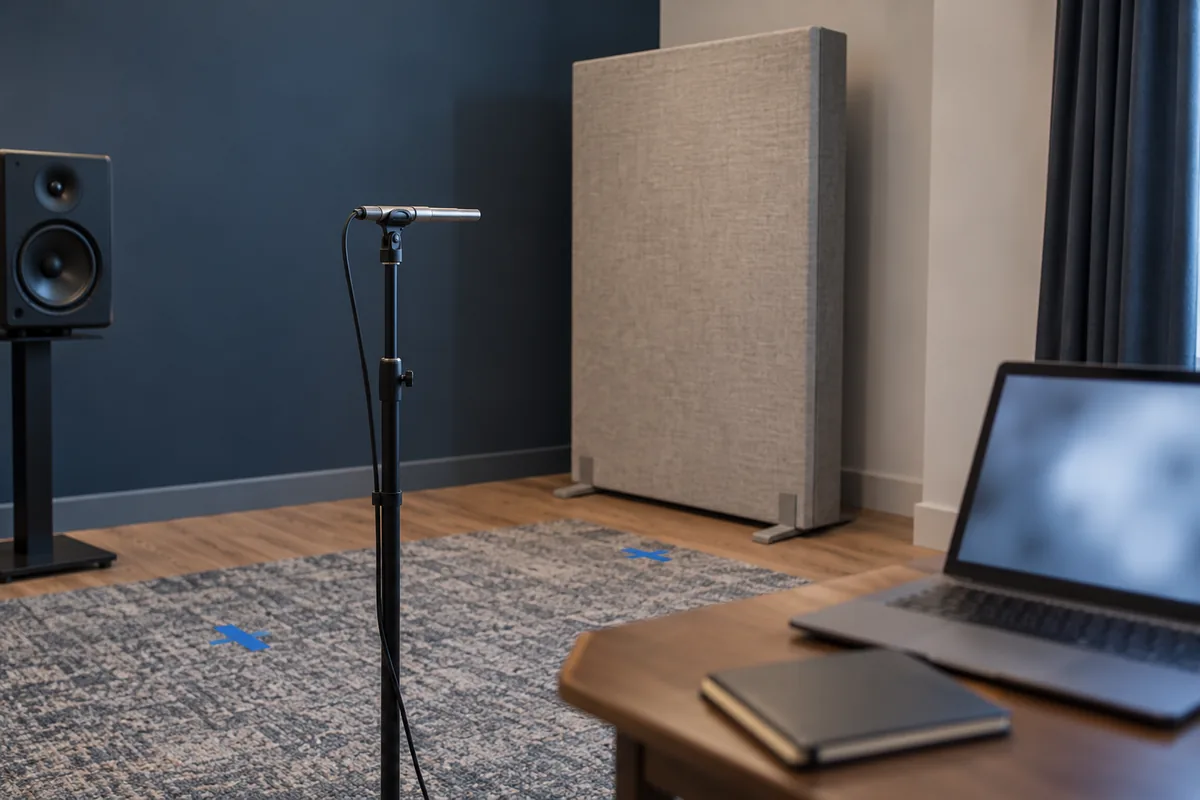
Change one variable at a time and compare the same microphone positions before committing to permanent placement.
Problem-to-action decision table
| Problem or symptom | Likely low-frequency cause | Treatment or placement priority | Limitation and verification |
|---|---|---|---|
| One-note boom with a long tail | Strong modal resonance | Test large porous coverage at relevant corners or boundaries; consider a measured tuned trap for a stubborn narrow band | Confirm shorter decay as well as lower level at more than one seat |
| Broad muddy bass | Several overlapping modes and long decay | Increase deep broadband coverage across multiple boundaries, then reassess sub integration | Thin broadband panels may change mids more than bass |
| Deep null at the main seat | Modal node, SBIR, or sub/main phase cancellation | Move the seat or source; adjust crossover, delay, and polarity; consider another sub | Traps and EQ rarely fill a severe cancellation on their own |
| Bass differs sharply between seats | Spatial modal variation and uneven source excitation | Test alternative sub positions or multiple subs before expanding treatment | A flat main-seat trace alone does not prove consistency |
| Peak improves but room sounds too dull | Too much uncovered porous treatment absorbing mids/highs | Use deeper placement, larger low-frequency volume, or a tested hybrid face where appropriate | Reflective facing changes upper-band behavior; verify the actual product data |
| Calculator predicts a mode but measurement is mild | Openings, damping, construction, or source/listener positions reduce excitation | Do not treat the number alone; investigate other measured bands | A calculator predicts possible resonances, not their audible severity |
This table is a triage tool, not a substitute for measurement. A peak that follows the listener around the room, a null that moves with the source, and a long-decay ridge may point to different physical decisions even when they occur near the same frequency.
What bass traps cannot replace
Bass traps are only one part of a low-frequency system. They do not provide sound isolation between rooms, repair rattling construction, or guarantee uniform bass across several rows. They also cannot compensate for a listening chair placed at an especially severe null if the source and receiver geometry remains unchanged.
Multiple subwoofers can excite room modes from different positions and improve seat-to-seat consistency. DSP and EQ can reduce remaining peaks after physical optimization, but boosting a deep cancellation consumes headroom and may make other seats worse. Treatment can lower resonant energy and decay, while positioning and multiple sources change how modes are excited. These tools complement rather than replace one another.
Do not confuse bass traps with ordinary decorative panels. Our guide to acoustic treatment panels explains how depth and mounting affect porous absorption, while the diffuser vs absorber comparison separates energy removal from scattering. Diffusion is not a substitute for low-frequency absorption unless a tested hybrid device also provides the required bass performance.
Choose evidence over corner-count rules
The most useful bass-trap plan is not the one with the largest number of products. It is the one that connects a measured problem frequency and decay pattern to an appropriate absorber mechanism and a plausible room location.
Start by optimizing the speakers, subs, and listening position. Use corners and long boundary junctions as high-value candidates, then verify them. Choose broad porous treatment for broad problems and measured, validated resonant devices for narrow ones. If the remaining issue is a deep cancellation, change the geometry or source strategy rather than expecting absorption to create energy where phase cancellation removes it.