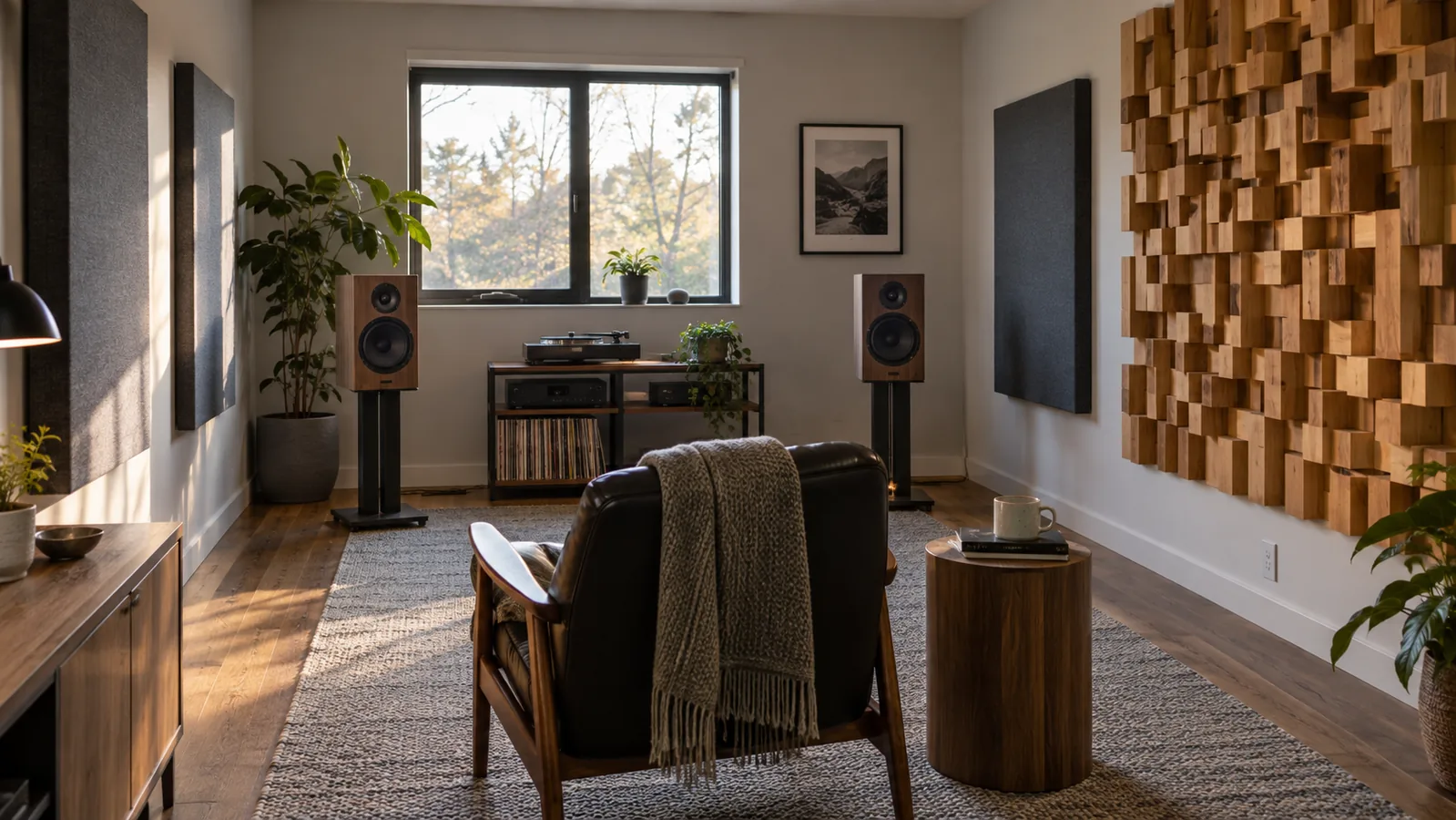
An acoustic absorber reduces reflected sound energy within the frequencies it can treat. A diffuser mainly redirects reflected energy across angles—and sometimes time—so one strong reflection becomes a less concentrated field. Neither is automatically “better.” Choose absorption when energy must be reduced; choose diffusion when useful room energy should be redistributed and there is enough distance for the device to work as intended.
In most small untreated rooms, the sensible order is speaker and seat placement, low-frequency diagnosis, bass control, and early-reflection control before diffusion. A diffuser is a refinement, not a substitute for those basics.
Acoustic Diffuser vs Absorber: The Practical Difference
| Decision dimension | Acoustic absorber | Acoustic diffuser |
|---|---|---|
| Primary job | Reduces reflected energy in a specified frequency range | Redistributes reflected energy across directions; some designs also spread arrival times |
| Typical target | Early reflections, excessive decay, flutter echo, microphone pickup of the room | Concentrated later reflections, uneven spatial distribution, loss of spaciousness after sufficient control |
| Effect on decay | Usually shortens decay where absorption is effective | Usually preserves more energy than an absorber, though real devices are not lossless |
| Frequency limits | Governed by material, depth, air gap, mounting and construction | Governed by surface geometry, overall size, element width/depth and incidence |
| Common locations | First-reflection zones, ceiling clouds, selected front/rear-wall areas | Rear wall or rear side walls when listening distance and design range are suitable |
| Main misuse | Too much thin absorption removes treble while leaving bass problems | Installing a shallow decorative surface and assuming it provides useful broadband diffusion |
The phrase sound diffuser vs absorber can make the choice sound binary. Real rooms often need both, but not in equal amounts or at interchangeable locations.
For the wider workflow of diagnosing reflections, placing panels and checking before-and-after measurements, use TFOOW’s acoustic treatment panels guide. This comparison stays focused on choosing the correct mechanism.
Keep Four Surface Functions Separate
Treatment decisions become easier when four categories are not blurred together.
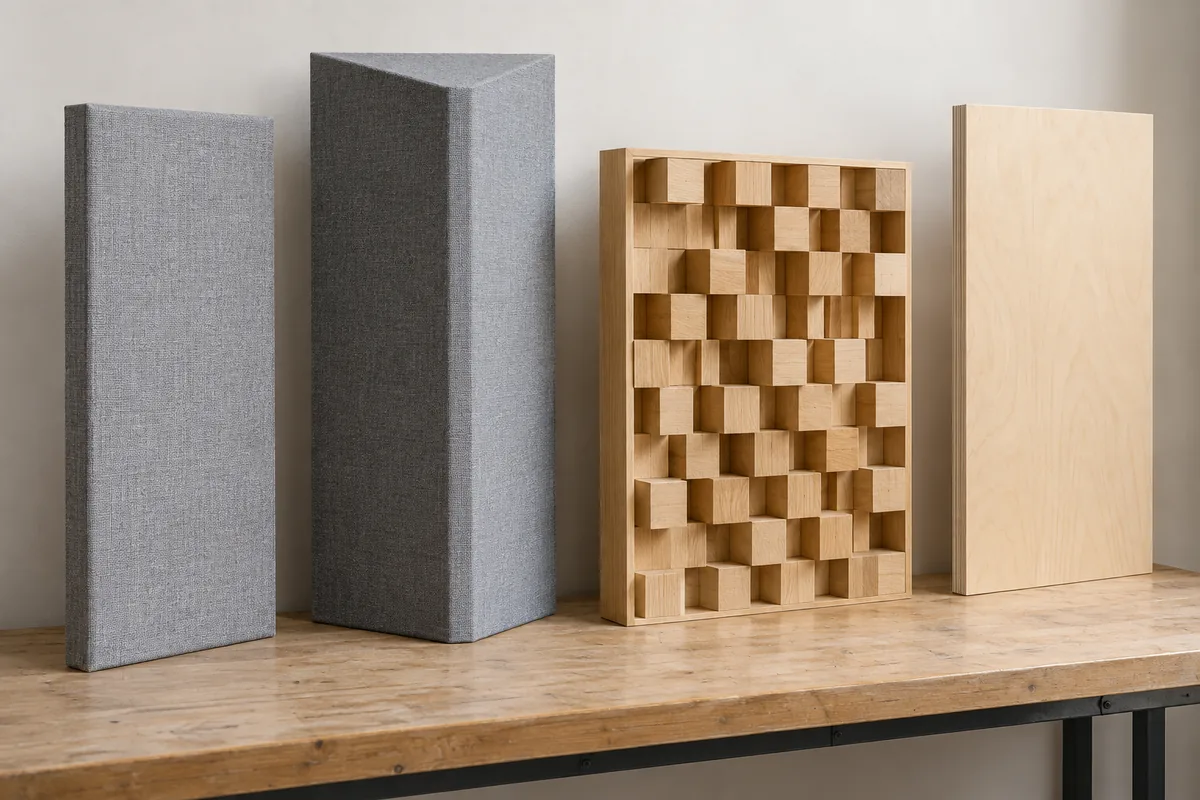
Broadband absorber
A porous panel allows oscillating air to move through a resistive material. Some acoustic energy is dissipated as heat, so less energy returns to the room. “Broadband” is relative: a panel may absorb broadly through the midrange and treble while becoming much less effective at low frequencies. Depth, flow resistance, mounting and any air space behind the panel matter.
Bass trap
A bass trap is an absorber intended to work lower in frequency. It may use substantial porous depth, a membrane or panel resonance, a Helmholtz-type mechanism, or a hybrid construction. A thin wall panel and a bass trap therefore do not become equivalent merely because both absorb sound.
Low-frequency peaks, nulls and decay also depend strongly on source and listener geometry. Before purchasing treatment, use TFOOW’s subwoofer placement guide to test whether a position change produces a larger improvement than adding material.
Diffuser
A diffuser uses deliberate geometry to break up a specular reflection. A one-dimensional device scatters mainly in one plane; a two-dimensional design spreads energy across two planes. QRD and PRD devices use number sequences to set well depths, while curved and other engineered surfaces use different mechanisms. The useful range belongs to the specific design—not to the word “diffuser.”
Reflective surface
A flat, hard surface primarily returns a concentrated reflection. An irregular bookshelf or decorative slat wall may add some scattering, but irregular appearance alone does not prove uniform diffusion. It is safer to call an untested surface reflective or scattering than to assume it performs like a characterised diffuser.
Absorption and Diffusion Use Different Measurements
Product numbers are useful only when they describe the property you need.
ISO 354 specifies a reverberation-room method for measuring the sound absorption coefficient of wall and ceiling treatments. ASTM C423 likewise measures absorption in a reverberation room and notes that laboratory coefficients require judgement in practical rooms because the sound field and specimen area differ (ISO; ASTM International).
An absorption coefficient is frequency-dependent. NRC compresses several mid-frequency absorption results into one rating; it is not a bass-performance score and says nothing about directional diffusion. Check the frequency-by-frequency data, specimen size and mounting condition instead of choosing the largest single number.
Diffusion needs different descriptors. ISO 17497-2 distinguishes a scattering coefficient—the proportion of reflected energy sent outside the specular zone—from a directional diffusion coefficient, which describes how uniformly the reflected energy is distributed by direction (ISO). A product can scatter sound without distributing it evenly. Absorption, scattering and diffusion data are therefore not substitutes for one another.
When comparing products, look for:
- test standard and laboratory or method;
- frequency-band results rather than one headline rating;
- specimen dimensions and mounting configuration;
- the reference surface used for normalized diffusion data;
- recommended listening distance and orientation for the exact diffuser;
- whether a hybrid product reports both absorption and scattering behaviour.
Why Small Rooms Usually Start With Absorption and Bass Control
Small rooms have short reflection paths and limited wall-to-listener distance. They also tend to have sparse, position-dependent low-frequency modes. Those conditions make strong early reflections and bass variation higher-priority problems than preserving a diffuse reverberant field.
Genelec’s monitor setup guide describes diffusion as mainly effective at mid and high frequencies, notes that low-frequency absorption needs substantial depth, and recommends absorption/diffusion combinations only where the room and location allow them (Genelec). The practical lesson is not “never diffuse a small room.” It is to avoid buying diffusion before the more consequential problems are identified.
Distance matters because the scattered field develops away from the surface. If a listener is very close, separate reflections from wells or facets may not combine as intended. There is no universal safe distance for every design; use the manufacturer’s design data or an acoustician’s model for the actual geometry.
Room Problem → Likely Treatment → Next Check
| Room problem | Likely first treatment | Placement consideration | Limitation to verify |
|---|---|---|---|
| Bright sound and excessive high-frequency decay | Broadband absorption | Add a controlled area at strong reflection zones, not every surface at once | Thin material may leave mid-bass and bass decay unchanged |
| Strong early side-wall or ceiling reflections at the listening seat | Absorption or redirection by room design | Treat the measured reflection path while preserving left-right symmetry | A diffuser too close may create uneven local reflections |
| Flutter echo between parallel hard surfaces | Absorption, diffusion, or a mixed alternating layout | Interrupt at least one of the opposing reflection paths | A clap test does not diagnose low-frequency behaviour |
| A few bass notes ring or vanish | Placement first, then suitable bass trapping | Test source and seat positions; traps often need depth or tuned construction | Ordinary thin panels and most diffusers will not solve deep modal nulls |
| Rear-wall reflection feels concentrated in a larger listening room | Purpose-designed diffusion, sometimes combined with absorption | Confirm listening distance, orientation and useful frequency range | Diffusion does not automatically reduce excessive decay |
| Room already has extensive absorption and lacks spatial energy | Remove/reposition some absorption or add qualified diffusion | Preserve early-reflection control while testing later-reflection zones | “More lively” is subjective; compare repeatable configurations |
This table is a starting hypothesis, not a remote diagnosis. The same audible complaint can have different causes. A bright tonal balance, for example, may come from loudspeaker response, placement or furnishings rather than insufficient absorption.
How the Choice Changes by Room Type
Two-channel listening room
Begin with symmetrical speaker/listener placement and identify first reflections. Absorption is the predictable choice when those reflections blur imaging. Diffusion becomes more plausible on a sufficiently distant rear wall or rear side wall when the room is already controlled but a more spatial later field is desired.
Home theater
Dialogue clarity, seat-to-seat consistency and bass decay usually come before adding diffusion. Multiple seats complicate the decision because a treatment that helps one path may affect another. Use absorption selectively around strong reflections and bass treatment where measurements justify it; consider diffusion where it can redistribute later energy without creating obvious hot spots.
Control room or home studio
Monitoring requires a reliable relationship between direct sound and room sound. Early-reflection control around the mix position is commonly absorption-led. A rear-wall diffuser can be useful when the room is deep enough and the design range matches the reflection, but a close rear wall often favours deep absorption or another engineered solution.
Recording or live room
The goal may be a useful room contribution rather than maximum neutrality. Movable absorbers, reflective boundaries and diffusion can create different capture zones. Here, the balance depends on instrument, microphone pattern, placement and desired decay; a control-room rule should not be copied automatically.
A Better Decision Sequence Than Buying by Panel Type
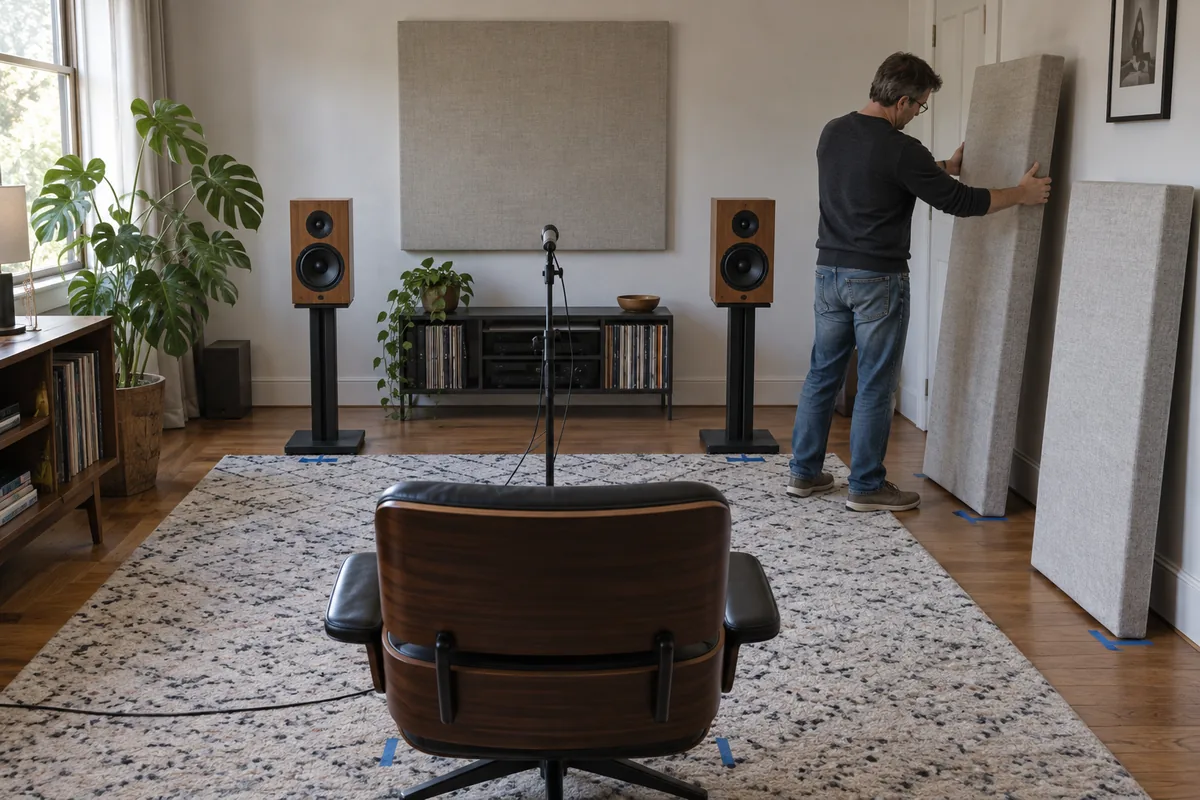
- Define the failure. Is the problem early reflection, excessive decay, flutter, bass ringing, a null, or a lack of spatial energy?
- Separate bass from mid/high-frequency issues. Frequency response and decay plots can show persistent low-frequency energy; an impulse response can help identify later arrivals. REW explains that these views describe different parts of the measured system (Room EQ Wizard).
- Record the geometry. Note room dimensions, speaker/listener locations, the available surface area and the distance from a proposed diffuser to the nearest listener.
- Match mechanism and range. Use absorption data for energy reduction, diffusion/scattering data for reflected distribution, and low-frequency evidence for bass traps.
- Test a reversible layout. Install a limited area, repeat the same measurement and listening material, then compare before expanding treatment.
For combined treatment, a useful pattern is to absorb the strongest harmful early reflections, address low-frequency decay separately, and use diffusion only on later-reflection surfaces where distance and bandwidth are appropriate. Hybrid panels can be practical, but their reflective face, open area and absorber depth create a new performance profile; they should not be assumed to equal a dedicated diffuser plus a full absorber.
Conclusion
Choose an absorber when reflected energy needs to be reduced in a known frequency range. Choose a diffuser when a concentrated reflection should be redistributed, the room already has reasonable decay control, and there is adequate distance for the design. Use bass traps as a separate low-frequency tool, and do not mistake a hard irregular surface for verified diffusion.
For most small rooms, start with geometry, bass and early reflections. Add diffusion only after measurements and controlled listening show that redistributing later energy solves a remaining problem better than removing more energy.
Sources
- ISO. “ISO 354:2003 — Measurement of sound absorption in a reverberation room.” Confirmed 2024.
- ASTM International. “ASTM C423-23e1 — Sound Absorption and Sound Absorption Coefficients by the Reverberation Room Method.” Updated August 9, 2024.
- ISO. “ISO 17497-2:2012 — Measurement of the directional diffusion coefficient in a free field.”
- Genelec. “Monitor Setup Guide.” Accessed September 28, 2026.
- Room EQ Wizard. “Signals and Measurements.” Accessed September 28, 2026.