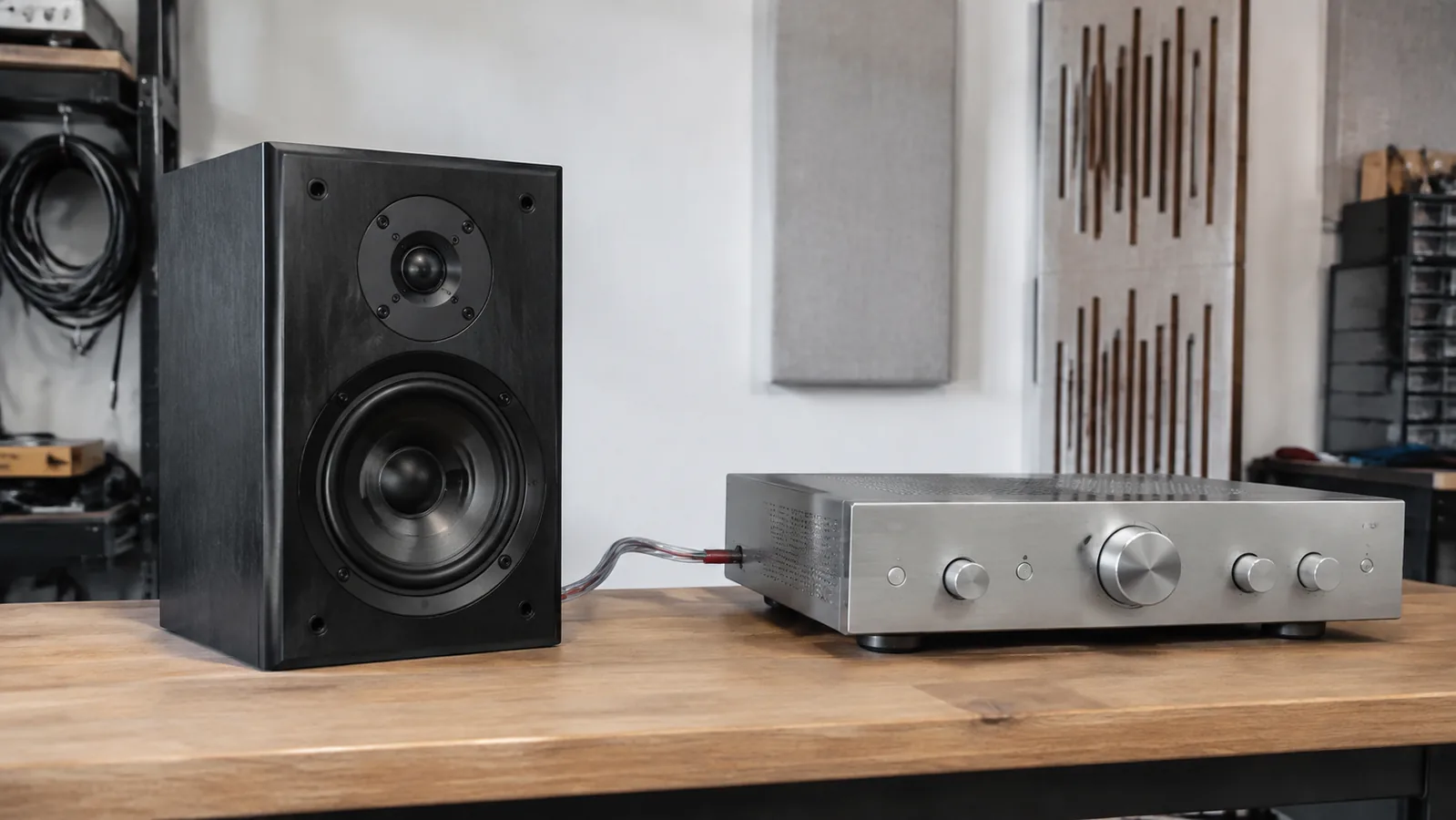
Speaker impedance describes the electrical load a passive loudspeaker presents to an amplifier. It is measured in ohms, but the number printed on a speaker is only a summary: real impedance changes with frequency. A safe match therefore depends on the speaker’s nominal and minimum impedance, the amplifier’s stated load capability, and the way the speakers are connected.
Quick answer: Do not try to make the number on the speaker equal an imaginary “amplifier impedance.” Instead, confirm that the amplifier or receiver is approved for the speaker load under the exact channel and connection conditions you will use. When a manufacturer publishes minimum impedance or an impedance curve, use that evidence alongside the nominal rating. Follow the equipment manuals whenever their instructions differ from a general rule.
Read Speaker Impedance as Three Pieces of Evidence
Decode a specification sheet by separating three related measurements. Treating them as one “ohms” number hides why some speakers are easy loads and others are demanding.
| Evidence | What it describes | Why it matters | What it cannot prove alone |
|---|---|---|---|
| Nominal impedance | A declared reference value for the speaker system | Provides a convenient compatibility category such as 4, 6, or 8 ohms | The lowest load at every frequency |
| Minimum impedance | The lowest magnitude reported in the measured range | Identifies a point where current demand may be higher | How difficult the load is when electrical phase is also considered |
| Impedance magnitude and phase versus frequency | The changing complex load across frequency | Shows where low magnitude and a reactive phase occur together | Whether a particular amplifier will remain within its limits at every volume |
A nominal number is useful, but it is neither a constant resistance nor a complete amplifier test.
Why Speaker Impedance Changes With Frequency
Resistance is the DC part of the story
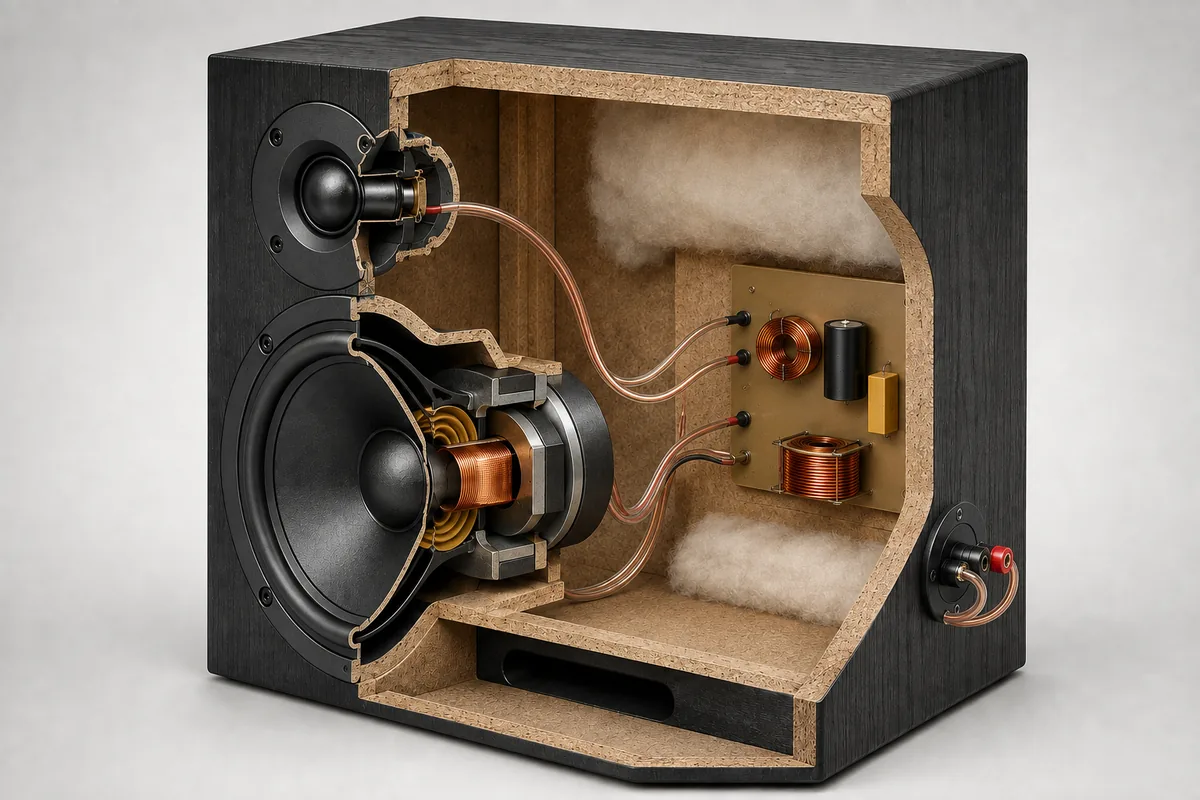
A basic resistor opposes current with a value that can remain nearly constant over the audio band. A loudspeaker is different. Its voice coil has resistance, but it also has inductance; the moving cone, suspension, air load, enclosure, and crossover components add frequency-dependent behaviour.
Impedance is the combined opposition to alternating current produced by resistance and reactance. Because music contains changing frequencies, the amplifier encounters a changing load rather than the fixed value suggested by a label.
Texas Instruments notes that the load of a real loudspeaker depends on its electromechanical properties, enclosure, and crossover network and is not flat across frequency (TI). This is why a multimeter reading and a nominal specification do not describe the same thing.
Resonance and crossovers shape the curve
At a driver’s resonance, mechanical motion and the enclosure can produce a pronounced impedance peak. In a multiway speaker, the crossover divides frequencies among drivers using inductors, capacitors, and resistive elements. Their interactions create additional rises, dips, and phase rotation.
Yamaha’s amplifier training material describes a loudspeaker as a coil with resistance whose impedance varies from its lower DC value to much higher values at resonance. It also explains that voltage and current can move out of phase, making a reactive loudspeaker more demanding than a simple test resistor (Yamaha).
A dip’s location matters as well as its depth. A broad low-impedance region carrying substantial musical energy may be more demanding than a brief minimum elsewhere.
What 4, 6, and 8 Ohms Really Mean
Four-, six-, and eight-ohm labels are compatibility categories, not sound-quality grades. A 4-ohm speaker is not inherently better or more accurate than an 8-ohm design. It generally asks for more current at the same voltage, but sensitivity, programme material, and amplifier limits affect the result.
The simplified relationship for a purely resistive load is:
- current:
I = V / R - power:
P = V² / R
At an idealised 20 volts RMS, the comparison looks like this:
| Fixed voltage and resistive test load | Calculated current | Calculated power |
|---|---|---|
| 8 ohms at 20 V RMS | 2.5 A RMS | 50 W |
| 4 ohms at 20 V RMS | 5 A RMS | 100 W |
This is a teaching calculation, not a performance promise. It assumes constant resistance, unlimited voltage and current, and no thermal or protection limits. A real amplifier may clip, current-limit, shut down, or deliver less as the load becomes harder.
Cambridge Audio similarly advises checking the amplifier specifications and suggested impedance ratings because a lower load can require more output and may cause overheating when the amplifier cannot supply it (Cambridge Audio).
Why Electrical Phase Changes the Load
Impedance has magnitude and phase. Magnitude is the ohm value commonly plotted on the vertical axis. Phase describes the timing relationship between voltage and current created by reactive elements.
A low magnitude can demand substantial current. A large phase angle at the same frequency can make that current harder for the amplifier to handle. The toughest point is not always the absolute impedance minimum.
An Audio Engineering Society paper on power amplifiers and loudspeaker loads identifies the reactive load and the time-varying nature of music as constraints on amplifier design (AES). For a reader comparing equipment, the practical conclusion is modest: published 4-ohm power is useful evidence, but it does not prove that every amplifier will behave identically with every 4-ohm loudspeaker.
How to Check Speaker and Amplifier Compatibility
1. Confirm which impedance you are looking at
First establish whether the speaker is passive. In an active loudspeaker, the manufacturer has integrated the amplifier with the drivers; its line-input impedance is a different specification and should not be compared with a passive speaker’s rating.
For a passive speaker, record the nominal impedance, stated minimum, and any manufacturer guidance about recommended amplification. If only a nominal value is available, do not invent a minimum from a rule of thumb.
2. Read the amplifier rating under the right conditions
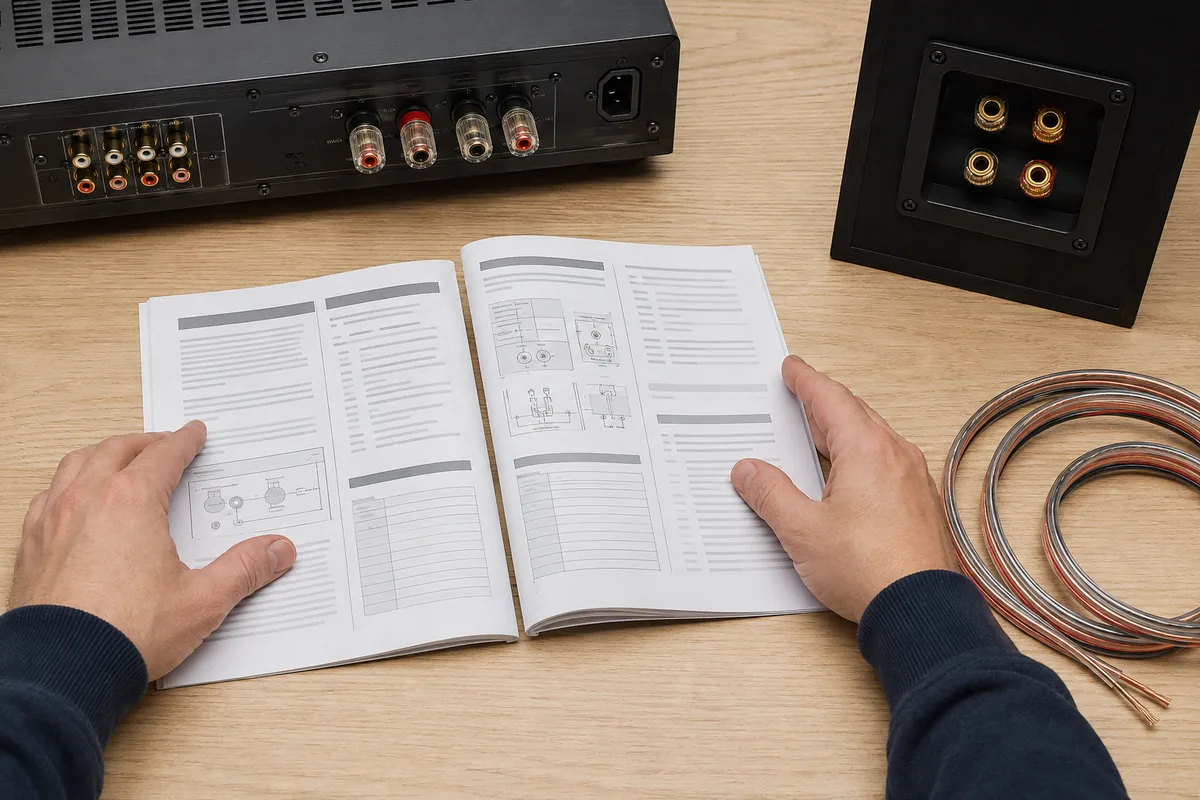
Look for the amplifier’s supported speaker impedance or minimum load in its manual. Also note whether the statement applies to one pair, A+B operation, bridged mode, bi-amping, or a particular group of channels. These configurations are not interchangeable.
The Yamaha RX-A4A manual, for example, offers model-specific 6-ohm-minimum and 8-ohm-minimum settings and explains which front-speaker loads are allowed under each selection (Yamaha RX-A4A manual). That table is evidence for that receiver, not a universal setting for every Yamaha or every amplifier.
3. Check how many speakers share one amplifier channel
Adding speakers to the same output changes the combined load. For ideal fixed impedances:
- series loads add:
Ztotal = Z1 + Z2 + … - parallel loads combine as:
1 / Ztotal = 1 / Z1 + 1 / Z2 + …
Two identical 8-ohm loads would equal 16 ohms in series or 4 ohms in parallel. However, real speakers have frequency-dependent impedance, and an A+B selector may use a topology that is not obvious from its labels. Use the amplifier or selector manual rather than assuming the outputs are simply parallel.
4. Separate load compatibility from power needs
An amplifier can be stable into a load yet lack the power needed for the target level. Conversely, an impressive watt rating does not prove low-impedance capability. Sensitivity, distance, desired peaks, and power handling are separate questions.
After electrical compatibility is established, physical setup still controls much of what you hear. For low-frequency consistency, continue with the site’s subwoofer placement guide rather than treating a different impedance label as a room-acoustics fix.
5. Treat heat, protection, and distortion as stop signals
If an amplifier becomes unusually hot, repeatedly enters protection, cuts out, or produces obvious distortion, reduce the level and switch the system off if necessary. Verify ventilation, wiring, and the manufacturer’s load requirements before continuing. Do not defeat protection circuits or change rear-panel impedance selectors while powered.
The exact procedure is model-specific. A Yamaha A-S801 manual, for example, warns that changing its impedance selector while power is on may damage the unit and gives different minimum speaker loads for one-pair and A+B use (Yamaha A-S801 manual).
What a Multimeter Can and Cannot Tell You
A multimeter in resistance mode applies DC. With the speaker disconnected, it can help identify an open circuit, a short, or approximate voice-coil resistance. It cannot reveal the full impedance curve, frequency-specific minimum, or electrical phase.
A nominal 8-ohm speaker may therefore show a lower resistance without being faulty. For compatibility, prefer manufacturer data or a traceable impedance measurement. Never connect a resistance meter across a powered amplifier output.
Common Speaker-Impedance Myths
- “The amplifier impedance must equal the speaker impedance.” In conventional home audio, the speaker is the load. The relevant question is whether the amplifier is designed to drive that load under the intended configuration.
- “Lower impedance means better sound.” Impedance describes electrical loading, not fidelity. Two speakers with different nominal ratings can each be well or poorly engineered.
- “A 4-ohm speaker always receives twice the power of an 8-ohm speaker.” That result belongs to an ideal constant-voltage, resistive calculation. Real amplifiers and loudspeakers introduce current, voltage, thermal, reactive, and protection limits.
- “The nominal rating tells the whole story.” Minimum magnitude, phase, frequency range, and duration can change how difficult the load is.
- “A multimeter verifies the advertised impedance.” It measures DC resistance, not the complete AC impedance curve.
- “An A+B button guarantees two pairs are safe.” The combined load and allowable speaker ratings depend on the amplifier’s internal arrangement and manual.
A Five-Line Compatibility Decision
Use this sequence before connecting a passive speaker system:
- Identify the exact speaker and amplifier models and download their official manuals.
- Record speaker nominal impedance, published minimum impedance, and relevant connection guidance.
- Record the amplifier’s permitted load for the actual channel mode and number of speaker pairs.
- Confirm that selector settings, bridging, bi-amping, or speaker switching follow the manual—not a generic internet diagram.
- Keep the amplifier ventilated, begin at a low level, and stop if protection, excessive heat, or clear distortion appears.
If either manufacturer withholds the information needed for a nonstandard multi-speaker arrangement, ask the manufacturer or a qualified audio technician. Guessing is not a compatibility test.
FAQ
Can I use a 4-ohm speaker with an 8-ohm amplifier?
Not from those two labels alone. “8 ohm” may describe a recommended minimum load, a selector position, or only a power-test condition. Check the amplifier manual for support at 4 ohms and note the channel configuration. If it is not rated for that load, do not assume low-volume use makes the pairing approved.
Can I connect 6-ohm speakers to an 8-ohm receiver?
Many receivers provide instructions for 6-ohm speakers, but the answer is model-specific. Use the receiver’s manual and consider every speaker connected to the shared amplifier section. Do not copy another model’s menu setting merely because the brand name is the same.
Does speaker impedance affect sound quality?
Not as a simple ranking. Impedance can influence how an amplifier behaves when current demand, phase, and output limits interact, but the nominal ohm label does not predict tonal accuracy, distortion, dispersion, or preference by itself.
Why does my 8-ohm speaker measure less than 8 ohms?
A multimeter measures DC resistance, while the 8-ohm label is a nominal AC impedance reference. The full speaker impedance changes with frequency. A lower DC reading can be normal, but use manufacturer service data when diagnosing a suspected fault.
Conclusion
Speaker impedance is best understood as a curve and a compatibility condition, not a quality score. Start with the nominal rating, look for the measured minimum and phase behaviour, and then read the amplifier’s permitted load under the exact connection mode you intend to use. Keep power demand, sensitivity, and room setup as separate decisions. When the manuals do not support a pairing, the safest conclusion is that the compatibility remains unverified—not that a convenient ohm rule has approved it.
Sources
- Texas Instruments. “How to Select an Audio Amplifier for Products With Internal or External Speakers.” Revised 2023. https://www.ti.com/lit/ta/ssztbk9/ssztbk9.pdf
- Yamaha. “Power Amplifiers Part Two — Handling Power.” Accessed September 8, 2026. https://usa.yamaha.com/products/contents/proaudio/training_support/micro_tutorial/20170921/index.html
- Cambridge Audio. “What Is Impedance?” Revised October 17, 2025. https://www.cambridgeaudio.com/usa/en/faqs/what-impedance
- Eric Benjamin. “Audio Power Amplifiers for Loudspeaker Loads.” Journal of the Audio Engineering Society, September 1994. https://secure.aes.org/forum/pubs/journal/?elib=6931
- Yamaha. “RX-A4A: Setting the Speaker Impedance.” Published February 2025. https://manual.yamaha.com/av/20/rxa4a/en-US/319526539.html
- Yamaha. “A-S801 Integrated Amplifier Owner’s Manual.” Accessed September 8, 2026. https://europe.yamaha.com/files/download/other_assets/3/332373/A-S801_om_G-1.pdf